


Georgia’s FM: No legal grounds exist for revoking visa liberalisation
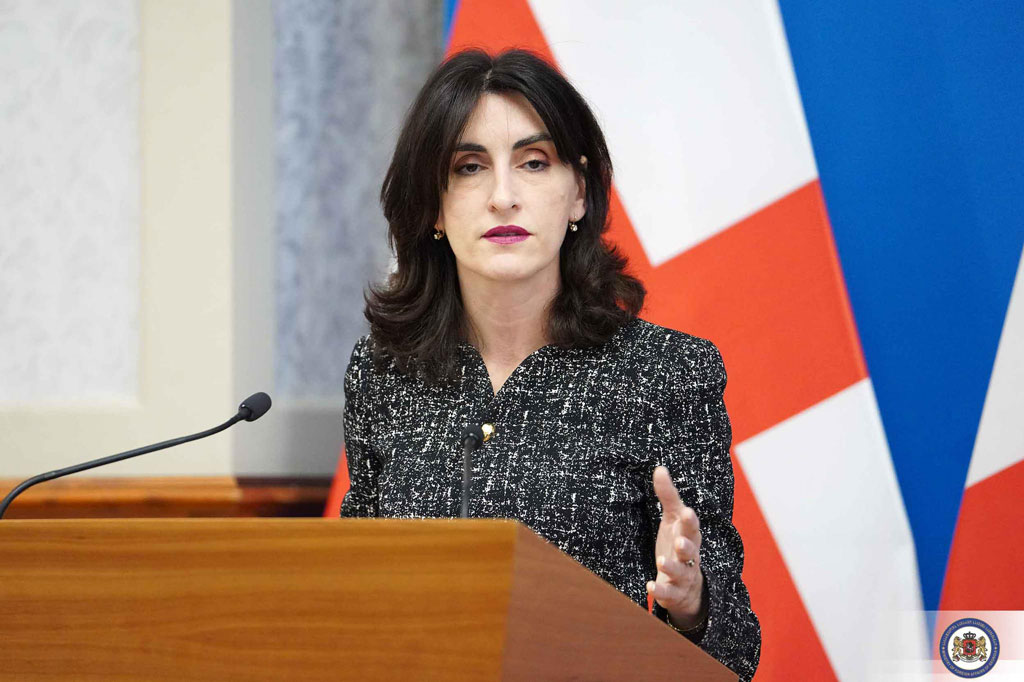
“No legal grounds exist today for revoking visa liberalisation,” Foreign Minister Maka Botchorishvili stated live on the Georgian Public Broadcaster’s First Channel programme “Actual Topic with Maka Tsintsadze”.
“The Georgian government has always acted and continues to act in good faith to ensure this benefit remains available to Georgian citizens, and it is entirely thanks to this government that Georgia’s population today enjoys visa-free travel to European Union member states within the Schengen zone.
There are no grounds whatsoever for revoking visa liberalisation. Naturally, we see that fantasies know no bounds. Many issues are being linked and connected to this matter. We have observed some attempts to introduce simplified procedures within the European Union’s own processes to facilitate the suspension of the visa-free regime. In a way, there are no other urgent issues currently facing the EU; we can link it to Georgia’s situation. However, this naturally requires certain procedures and support, and this support must exist among EU member states; there must be grounds, of course, for the European Union to make such a decision,” Botchorishvili stated.
According to her, the public is aware that Georgia was required to provide additional information on certain reports, which the Foreign Ministry, based on actions taken by various Georgian government bodies, submitted to the European Union.
“Naturally, we most often hear the phrase suggesting that Georgia’s government is doing nothing to protect visa-free travel, and to those who say this, we should probably ask what exactly the Georgian government is not doing to protect visa-free travel.
Naturally, we arrive at two laws that are currently being exploited to undermine Georgia’s interests, laws that have absolutely nothing to do with visa-free travel or our citizens’ freedom of movement within EU member states. I, too, am a politician who deliberately supported the Transparency Law and the Law on Family Values, because I believe they are essential for our country’s security and stability. There are very serious reasons why Georgia’s legitimate government, the parliament elected by the people, enacted these two laws.
These are entirely legitimate decisions by a government elected by the people, a parliament elected by the people, behind which stands the electorate, and we, the Georgian Dream government, cannot betray our voters, those people who stand behind us, at the cost of any blackmail,” Botchorishvili declared.
When the programme presenter, Maka Tsintsadze, inquired why these two laws are being equated with fulfilling presumed obligations under these circumstances, Maka Botchorishvili explained that the public remembers the events surrounding these laws, particularly in relation to the Transparency Law.
“This was completely unacceptable, because transparency would have hindered the activities or operations of those organisations in the sense that it would have become transparent to our society who finances the politicians, and where our political opposition is financed from, how the so-called non-governmental sector and civil society participate in Georgian politics. We cannot deceive our society. Naturally, our society needed to know this, had to be informed, and that is precisely what the law concerning the transparency of non-governmental organisations achieved. This was essential for the stability and security of our country. That is exactly why these decisions were made,” Botchorishvili stated.
The Foreign Minister also remarked that any European state would do the same if it were necessary to safeguard its security and stability.
“Any state would be receptive to the idea that foreign country financing and interference in their domestic affairs pose a threat. Therefore, Georgia should not be an exception in perceiving certain risks in this regard when it comes to foreign interference and foreign financing,” declared Maka Botchorishvili.
“One thing is regrettable, which became apparent from 2022, that the issue of European Union integration, which is very important for our country and in a way relates not only to foreign policy but also to history, culture, and identity, for many is merely an instrument. We saw this only in 2022,” Georgia’s Foreign Minister Maka Botchorishvili stated.
Speaking further on the programme “Actual Topic with Maka Tsintsadze,” the minister stated that it became evident that European integration, which is highly significant for Georgia, is for others merely and solely an instrument of political struggle.
“After Georgia made its application for EU membership, this application related to the Georgian people’s will, to numerous reforms implemented by Georgia’s government, which brought Georgia to the position where we had this opportunity, we saw the attitude that related to granting candidate status. It became evident that European integration, which is of great importance to us, is merely a tool for political manoeuvring for others. We observed how it was used to sway Georgia’s domestic politics.
The issue of European integration even became something of a plaything in the hands of the opposition. This is precisely what we have said, that we do not want such an attitude; for us, it is a very important matter, as it damages relations with the European Union and cannot continue in this way,” stated Botchorishvili.
“Georgia requests only one thing from the European Union: that fair assessments are made and that there is a just attitude towards Georgia’s government, which is supported by the vast majority of the population. Brussels should consider this,” Georgia’s Foreign Minister went on to say.
According to the minister, today Brussels itself is damaging attitudes towards the European Union in Georgia.
“The government has spared no effort from 2014 to the present to ensure that European integration remains a popular issue within society. I can recall when we signed the Association Agreement, support was then at 65 per cent, but over ten years, this figure changed dramatically, rising to 85 per cent. This achievement is due to the efforts of Georgia’s government and its work. Today, Georgian society can see the attitude of European bureaucracy towards Georgia, and this is unfair, constant, groundless criticism,” Botchorishvili noted.
According to the head of Georgia’s foreign ministry, it is complicated to deceive Georgian society.
“Constant exposure to false narratives, misleading statements, and resolutions undermines reputations. Today, the European Parliament no longer commands the same level of respect within Georgian society that it might once have held. We frequently see resolutions filled with lies that are entirely inconsistent with the realities on the ground. Brussels itself perpetuates this situation, damaging its own credibility and the favourable perception it has cultivated. Recent polls indicate that this popularity is steadily declining.
I believe Brussels, and indeed the European Union, should reflect on this for a simple reason: we need each other. We require dialogue and strong relations, and these must not be unjust but founded on fairness. We must strive to reach a point where our approach to one another is just and equitable.
Georgia requests only one thing from the European Union: that fair assessments are made and that there is a just attitude towards Georgia’s government, which is supported by the vast majority of the Georgian population, those who Georgian society votes for and who ultimately win. It deserves to be treated fairly,” declared Botchorishvili.