


GD’s Gorduladze: Georgia held nine nationwide elections since 2012, opposition repeatedly refused to recognize elected officials’ legitimacy and continues to engage in sabotage
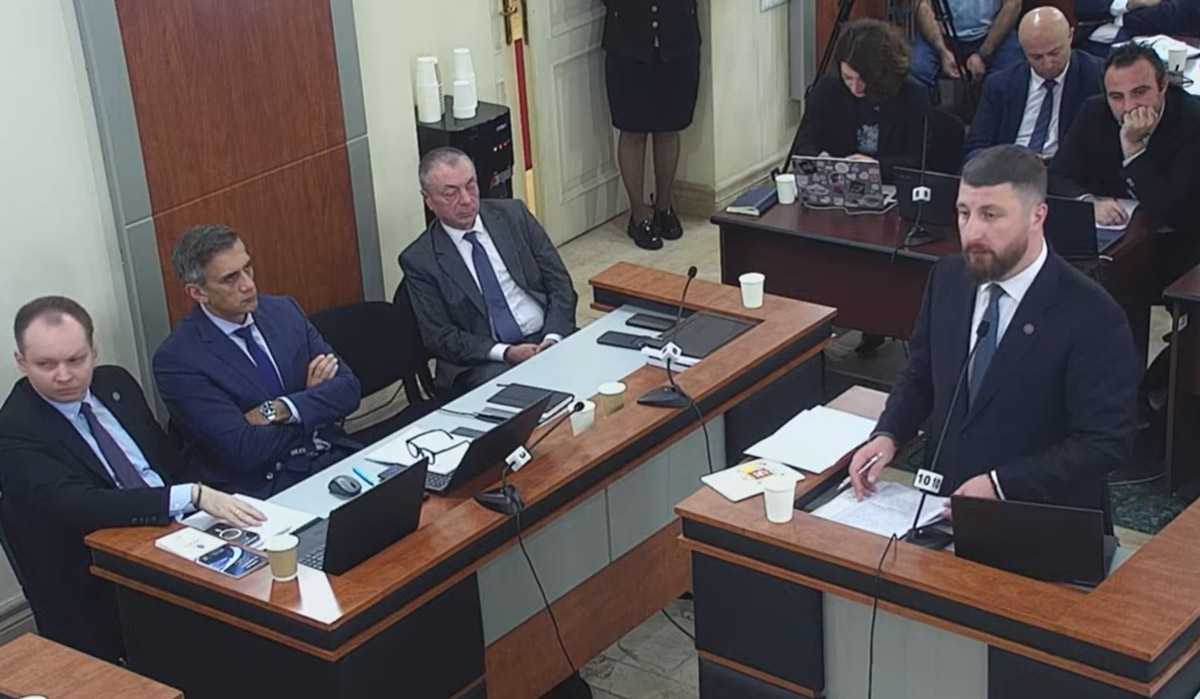
Archil Gorduladze, Chairman of the Legal Issues Committee of the Parliament of Georgia, addressed the alleged objectives of opposition parties to “overthrow and violently alter the constitutional order of Georgia” while speaking before the Plenum of the Constitutional Court.
According to Gorduladze, opposition parties have consistently engaged in what he described as sabotage against the Georgian state.
“Since the parliamentary elections held on October 1, 2012, nine general elections have taken place in Georgia. On several occasions, these parties have refused to recognize election results or the legitimacy of elected bodies and officials, thereby remaining in a constant state of sabotage against the Georgian state.
Following the 2016 parliamentary elections, the first attempt was made to declare the government, democratically elected by the people, illegitimate. The National Movement, citing the false pretext of the elections’ illegitimacy, even boycotted the second round of voting. However, the party later began exercising its mandates in the Parliament of Georgia — a fact that irrefutably demonstrates that there was no basis whatsoever for declaring the elections illegitimate.
“In 2018, a coalition led by the National Movement refused to recognize the results of Georgia’s presidential election and attempted to disrupt the inauguration ceremony of the newly elected President through violent means.
In June 2019, the National Movement and other closely affiliated political parties attempted to storm the Parliament building in Georgia, a fact confirmed by a ruling of the Strasbourg Court.
Following the 2020 parliamentary elections, certain unconstitutional political parties declared the elections illegitimate, refused to participate in the work of the newly elected Parliament and attempted to storm the administrative building of the Central Election Commission of Georgia. Nevertheless, they subsequently resumed exercising their parliamentary mandates, which irrefutably confirms that there was no basis whatsoever for declaring the elections illegitimate.
Following the 2021 local self-government elections, unconstitutional political parties once again declared the elections illegitimate, organized protests in various cities and renewed their demand for repeat elections. However, they subsequently resumed exercising their mandates in local self-government bodies — a fact that clearly demonstrates that there was no basis for declaring the elections illegitimate.
Following the 2024 parliamentary elections, the parties that surpassed the electoral threshold rejected the election results, renounced their parliamentary mandates and declared the newly elected Parliament illegitimate. Furthermore, in the aftermath of the elections, these unconstitutional political parties facilitated and carried out actions that included a forcible entry into the Parliament Palace of Georgia.
In the months leading up to the local self-government elections on October 4, 2025, unconstitutional parties conducted an active public campaign and issued public statements explicitly calling for the overthrow of the Georgian government and its replacement through a revolution on October 4, 2025. Their statements also clearly indicated preparations for such action. The relevant unconstitutional political parties openly supported this action, whose stated objective was to overthrow the Georgian government.
Although the authors of these calls often used the word ‘peaceful’ alongside the term ‘overthrow,’ this does not alter the violent and unlawful nature of the calls. The phrase ‘peaceful overthrow of the government’ combines mutually exclusive terms — an oxymoron — and unequivocally points to an intent to rely on violence and to alter Georgia’s constitutional order through unlawful means,” Gorduladze said.
According to Gorduladze, the violent rally organized on October 4 with the aim of overthrowing the government was also supported by Lelo.
“They even had a campaign: ‘To the polls in the morning, and to Rustaveli Avenue in the evening.’ This is confirmed by Irakli Kupradze’s statements on September 15 and October 3: ‘Let’s go to the polls in the morning and during the day, and stand on Rustaveli in the evening,’ and ‘Our message regarding how to act on October 4 is as follows: to the polls in the morning, and supporting the protest in the evening,’” Gorduladze said.
According to Gorduladze, the political party Gakharia for Georgia cited the failure of the attempt to overthrow the Georgian government through a revolution on October 4, 2025, as one of the reasons behind its decision on whether to exercise its parliamentary mandates.
“Giorgi Sharashidze stated: ‘It is already too late; unfortunately, this is an accomplished fact. And we said from the very beginning that we would make this decision based on the political situation that would exist in the country after October 4.’ Levan Gogichaishvili said the same thing,” Gorduladze said.
It is a fact that there is a distinction between their public statements and their actual objectives. They were anticipating the political consequences of the government’s overthrow, and once that overthrow failed to materialize, they entered the Parliament — an institution they continue to label illegitimate.
In 2025, Aleko Elisashvili, a representative of Lelo, attempted to set fire to the Tbilisi City Court building, an act for which he has been convicted of committing a terrorist offense. Nevertheless, representatives of the Lelo party characterized the case against Aleksandre Elisashvili as a ‘fabricated charge,’ an act of ‘lawlessness,’ ‘retribution’ and ‘political settling of scores,’ while describing Elisashvili himself as a ‘political prisoner,’ a ‘politically persecuted person,’ a ‘captive of the regime’ and a ‘victim of political repression,’” Gorduladze said during the Constitutional Court hearing.