
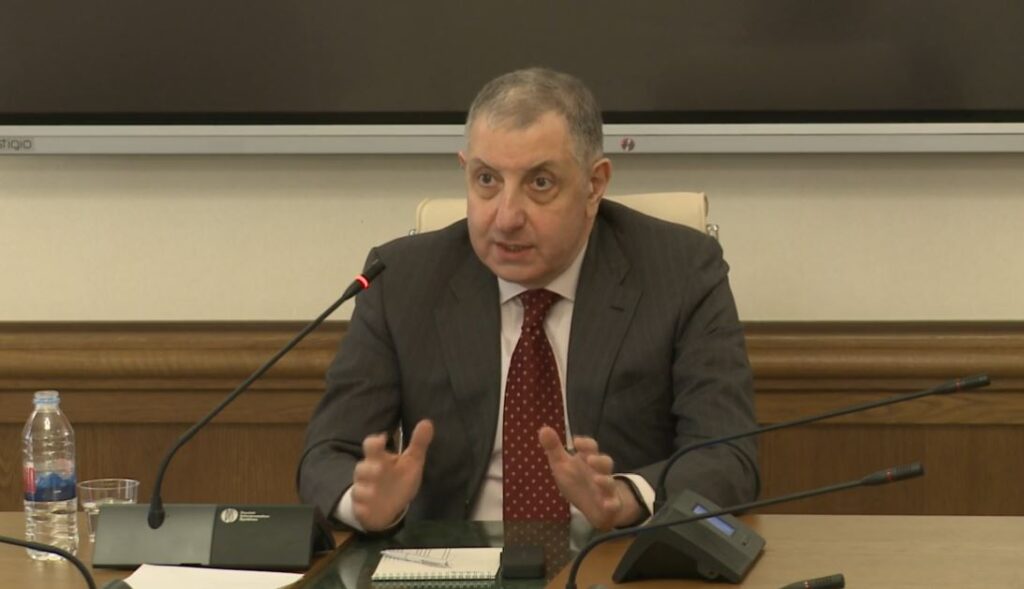
“We have always managed to avoid hostilities. We succeeded in doing so in 2006 when we found ourselves on the brink of war, and I am absolutely certain that this should have been the case in 2008 as well,” declared Zurab Noghaideli, who served as Georgia’s Minister of Finance from 2003 to 2004 and as Prime Minister until November 2007. He made this statement during a session of the parliamentary investigative commission, investigating activities of 2003-2012 regime and its political officials.
The head of the investigative commission, Tea Tsulukiani, posed a pointed question to Noghaideli: “You effectively inherited the same cabinet as Prime Minister, with the exception of a new Minister of Finance. During that period, Defence Minister Irakli Okruashvili declared, ‘We will meet in Tskhinvali for the New Year.’ Was this statement coordinated with you, and to what extent did you agree with it?”
Noghaideli replied, “Not only was this statement by the Minister of Defence not agreed upon with me, but none of his statements were coordinated with me, nor should they have been.”
He elaborated, “There was a completely different governance structure in place. As the head of the cabinet, my constitutional authority was primarily focused on economic matters and related social issues. Defence, security, and foreign policy were the exclusive prerogatives of the president. Consequently, not only did I not agree with the Minister of Defence on this statement, it also contradicted established protocols. It was an utterly unnecessary and unhelpful comment. We all knew very well that Irakli Okruashvili would not be celebrating the New Year in Tskhinvali, and today we are even more certain of that. This is just one example; the crisis constantly revolved around similar statements and actions at that time, and many such unnecessary provocations occurred. We faced numerous complex issues, and at one point, we teetered on the verge of conflict, which we barely averted with considerable effort in 2006. Unfortunately, there were many such counterproductive statements and crises. Despite this, we consistently managed to avoid hostilities, and I firmly believe we should have done the same in 2008.”
Tea Tsulukiani pressed further, asking, “Constitutionally, the Ministers of Defence, Justice, Internal Affairs, and Foreign Affairs were not subordinate to you, but the State Minister for Conflict Resolution was—Giorgi Khaindrava, who was seen as successful for his peace initiatives, having visited Sokhumi and Tskhinvali to promote reconciliation. Why did you dismiss him? The public viewed this as a setback for the peace process.”
Noghaideli responded, “This decision was not directly linked to the peace process or Giorgi Khaindrava’s initiatives; it was more about my relationships with other Cabinet members. The peace process could have continued unaffected at that time. Although it is clear that the subsequent ministers did not possess the same initiative and capabilities as Giorgi Khaindrava.”
When asked whether he had disagreements with then-President Mikheil Saakashvili, Noghaideli admitted, “We often engaged in conflicts and quarrels, primarily over economic and financial matters. Yet there were also many issues that, while not directly concerning the Tskhinvali region, were significant. Naturally, we disputed his statements, but there were even more pressing and complex matters to address. For instance, regarding the 2006 conflict, Okruashvili’s resignation precipitated tensions in Tskhinvali, pushing us to the brink of armed conflict, which we managed to defuse through intense negotiation. I found myself arguing with the president about our response. We didn’t come to blows, but we were certainly at odds. While I didn’t know his exact plans with the Minister of Defence, it was clear that the situation was escalating.
I am not here to equate this situation with that of 2008 to pat myself on the back. I simply believe that both scenarios were avoidable—and they were. I don’t want to convey that I alone was responsible; it was certainly the result of a collaborative effort. I can’t recall whether foreign powers intervened at the time, but I know that our partners were engaged in the discussions.”
In closing, Noghaideli underscored, “I do not claim sole credit for the avoidance of conflict; it was a result of complex conversations involving various stakeholders.”