


FM Maka Botchorishvili: Our goal is building partnerships grounded in trust and reliability
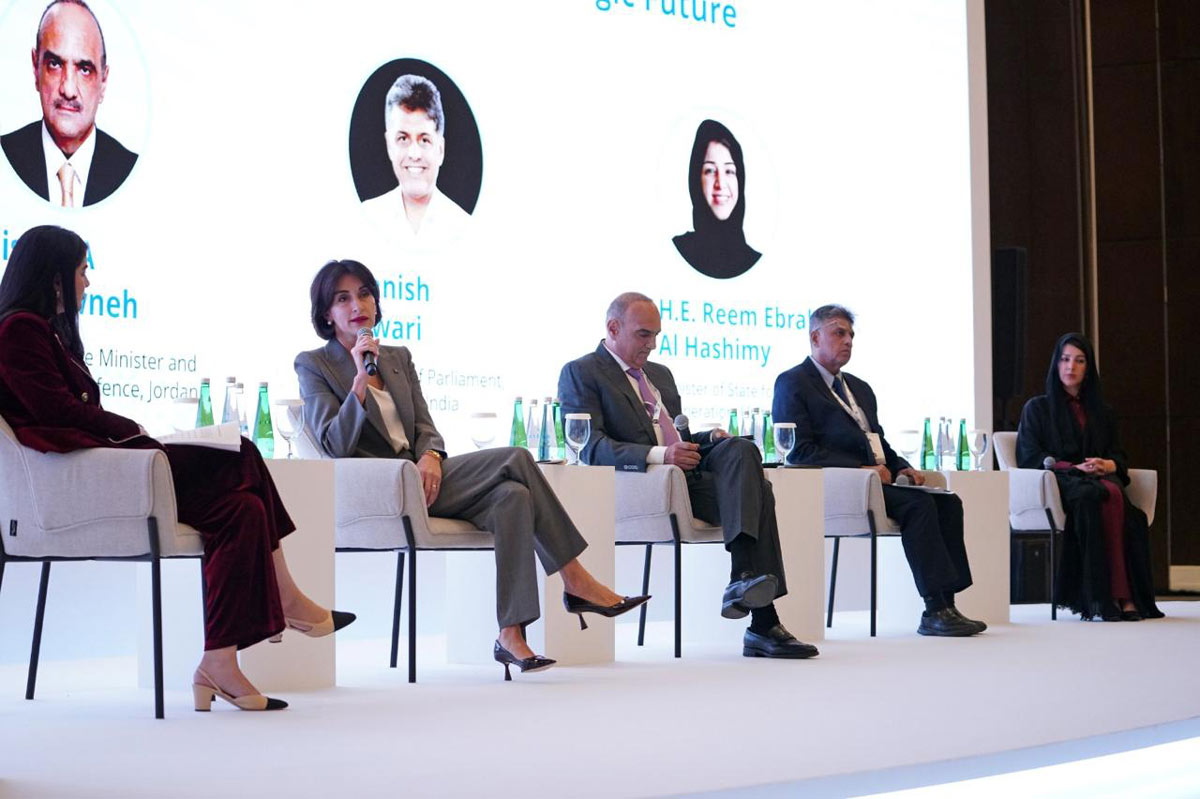
Georgia’s Vice Prime Minister and Minister of Foreign Affairs, Maka Botchorishvili, has taken part in the Raisina Middle East conference in Abu Dhabi, United Arab Emirates. The minister addressed a panel discussion entitled “Resilience, Partnership, and the Way Ahead: The Strategic Future of the Gulf Region.”
According to the Ministry of Foreign Affairs, Minister Botchorishvili’s address highlighted the geopolitical context, the importance of Georgia-UAE economic cooperation, their regional partnership, and opportunities to develop the Middle Corridor.
The Foreign Minister highlighted Georgia’s geopolitical positioning and its access to international markets, noting that existing economic partnerships with various nations create additional opportunities for the country.
“Georgia has signed 16 free trade agreements, which further elevates the significance of our efforts in the region. Georgia is a small country, but it occupies a highly strategic geopolitical location. The economic partnerships we develop bring added value to Georgia. We have free trade agreements in place with the European Union, all neighbouring countries, CIS states, China, the United Arab Emirates, and various other regions. This creates unique opportunities for Georgia,” Maka Botchorishvili stated.
The Minister also highlighted the regional significance of Georgia-UAE cooperation, emphasising that their bond transcends bilateral relations to foster broader regional collaboration.
“Our cooperation and partnership undoubtedly extend beyond the scope of bilateral relations and influence the development of regional cooperation. Both regions are exceedingly important, and the connections between them acquire great significance in the context of broader regional, and potentially global, cooperation,” the Minister noted.
Maka Botchorishvili emphasised the Middle Corridor’s critical role in driving regional cooperation and economic connectivity.
“Today, Georgia connects not only the South Caucasus to European and global markets, but Central Asian nations as well. This is of particular importance from the perspective of developing East-West connectivity,” Maka Botchorishvili said.
The Minister also discussed the impact of regional conflicts, noting that developments following the dissolution of the Soviet Union hindered the South Caucasus from establishing itself smoothly as a connective hub. Nevertheless, Georgia, Azerbaijan, and Turkey succeeded in executing numerous energy and transit projects that today provide a solid foundation for strengthening regional connectivity and further advancing the Middle Corridor.
According to Maka Botchorishvili, fully realising the region’s potential requires deepening cooperation, building trust-based partnership, and expanding opportunities for future collaboration.
“Our task is to build a partnership based on trust and reliability, not only in times of crisis, but during periods of stability as well,” Maka Botchorishvili noted.
The Vice Prime Minister also underscored the importance of investing in infrastructure development and expanding interregional cooperation.
“We talk about dependency, and dependency is certainly not the path to achieving resilience. That is precisely why diversification, developing new avenues of cooperation, and establishing partnership relations are essential,” Maka Botchorishvili stated.
The panel discussion also featured Reem Ebrahim Al Hashimy, UAE Minister of State for International Cooperation; Manish Tewari, Member of the Lower House of the Parliament of India; and Bisher Al-Khasawneh, former Prime Minister and Minister of Defence of Jordan. Ashok Malik, Partner and Chair of The Asia Group, moderated the session.