


Finance Minister: Georgia achieves sustainable growth amid geopolitical challenges
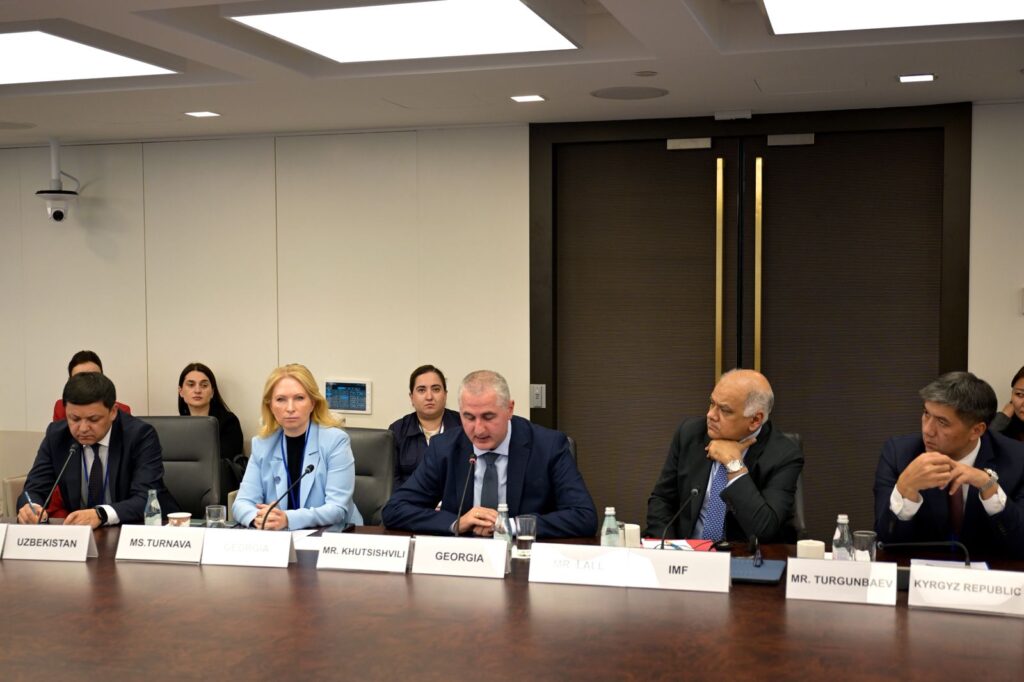
Georgia has maintained sustainable economic development despite ongoing geopolitical pressures, Finance Minister Lasha Khutsishvili said during a joint meeting of Finance Ministers and Central Bank Governors of Central Asian and Caucasus countries with IMF Deputy Managing Director Bo Li.
Khutsishvili noted that when shaping sectoral policies and determining reform and investment priorities, Georgia is focused on strengthening and expanding its role as a connectivity hub.
According to the Minister, 7–8% of GDP is currently directed toward capital expenditures, including major infrastructure projects such as the East-West Expressway, new power transmission lines and other strategic investments.
He also highlighted recent progress in simplifying public services, advancing digital taxation systems and improving customs controls.
“As of today, Georgia is a member of the EU’s new computerized transit system (NCTS). Trade agreements are in force with the EU, China and, in total, 47 countries and the Customs Union, while double taxation avoidance agreements have been signed with 58 countries. These achievements required major legislative and regulatory reforms and the development of digital platforms. The results are already visible: according to the B-Ready survey, which will replace the World Bank’s Ease of Doing Business Index, Georgia ranks 3rd in regulatory framework, 14th in public services, 2nd in operational efficiency and 1st in budget transparency,” Khutsishvili said.
He added that over the past five years, Georgia’s economy has grown at an average rate of 9% annually, with inflation remaining near the target level, a doubling of GDP per capita, structural changes in the economy, and growth in exports of services such as education, ICT and tourism.
Speaking about regional connectivity, the Minister stressed the importance of completing the remaining highway links to the borders of Armenia, Azerbaijan and Turkey.
“We are working with Azerbaijan to introduce joint border checkpoints under a single-window system, which will simplify procedures and improve infrastructure. We are also preparing to expand transmission lines and to build underwater electricity and digital cables. In addition, Georgia is investing in a new deep-water port and planning the construction of a new airport. The Middle Corridor has always had strategic importance — that is why we began investing in it decades ago. To ensure it functions as an efficient and stable route, and as a viable alternative to other transit corridors, even deeper cooperation among South Caucasus and Central Asian countries, along with continued support from international financial institutions, is essential,” Khutsishvili stated.