


Economy Minister: Georgia’s railway, port and logistics are fully compatible with EU transport infrastructure
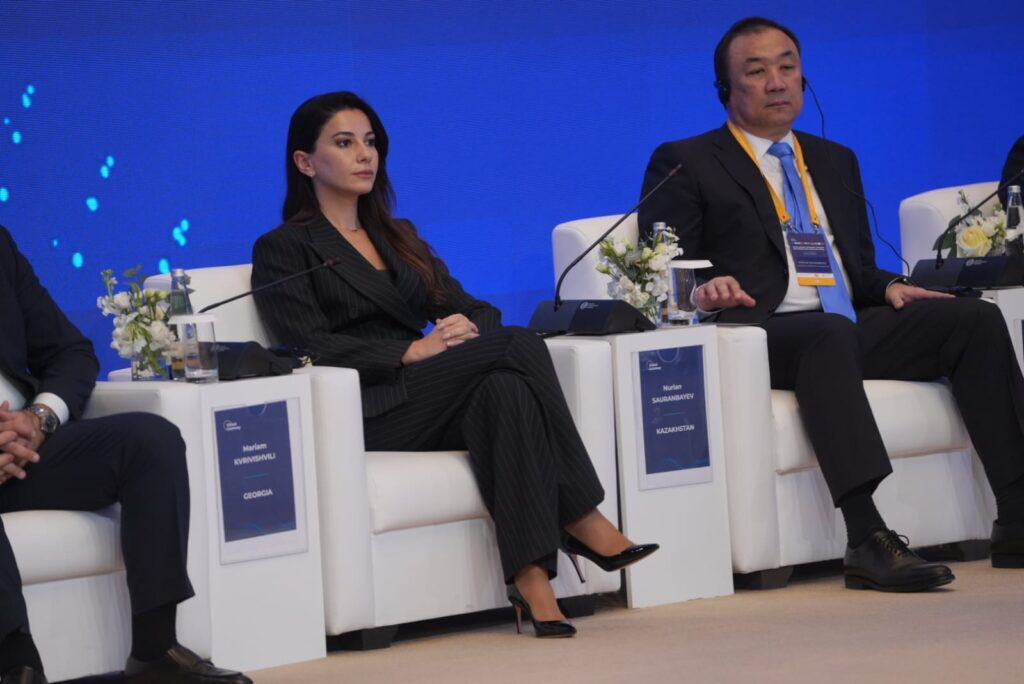
Economy and Sustainable Development Minister Mariam Kvrivishvili has participated in the Second Investors’ Forum on the Trans-Caspian Transport Corridor and Connectivity, held in Tashkent, Uzbekistan, and co-organised by the European Union under its Global Gateway initiative.
According to the Ministry of Economy, the forum was inaugurated by Jamshid Khodjaev, Deputy Prime Minister, Uzbekistan, Ilhom Mahkamov, Minister of Transport of Uzbekistan, European Commissioner for International Partnerships Jozef Síkela, and European Commissioner for Enlargement Marta Kos.
Minister Kvrivishvili participated in a panel discussion focusing on connectivity development across Central Asia, the South Caucasus and the Black Sea region.
The Minister highlighted Georgia’s significant state investment in transport infrastructure, which has substantially reduced both transport and travel times whilst improving road safety standards.
Kvrivishvili drew attention to several major projects, including the East-West Highway, over 70 per cent of which is now operational. She also cited the modernisation of Georgia’s main railway line as a crucial development, which has increased capacity and reduced transit times, specifically cutting container wagon transport times from 24 hours to 12 hours, facilitating more efficient, faster and reliable freight movement along the East-West corridor.
“Next year will see an expansion of railway rolling stock to meet growing demand for transit and export cargo. The Baku-Tbilisi-Kars (BTK) railway is nearing completion, with full operational activation scheduled for the end of this year. The project will facilitate smooth and efficient connectivity between Georgia, Azerbaijan, and Turkey, as well as along the entire corridor,” stated Kvrivishvili.
The Minister identified the development of Anaklia Deep-Sea Port as another strategic project. According to her, Anaklia Port will accommodate large container vessels and become a key maritime hub for transit between Europe and Asia.
“This project is further supported by the expansion of ferry services to EU ports, including Constanța, Burgas and Varna, as well as the development of logistics zones and dry ports to facilitate multimodal operations,” Kvrivishvili noted.
The Economy Minister emphasised that Georgia’s transport and connectivity agenda is clearly defined and reinforced by EU initiatives.
“The expansion of the Trans-European Transport Network encompasses Georgia’s key railway, port and logistics projects, which are fully compatible with the EU’s transport network. Consequently, investments made in Georgia are synchronised and entirely compatible with the broader European network. Georgia’s role in the EU’s Global Gateway initiative is unambiguous. By positioning the Black Sea as a strategic gateway, protecting transit routes and facilitating trade, Georgia strengthens the resilience of the entire European and Asian continents, transforming from a transit country into a connecting hub,” Kvrivishvili declared.
The Georgian delegation at the forum also included Deputy Ministers Tamar Ioseliani and Genadi Arveladze.
The Trans-Caspian International Transport Route (TITR), also known as the Middle Corridor, connects Asia and Europe via the South Caucasus and Central Asia, bypassing Russia.