


Deputy Economy Minister initiates negotiations on CAREC trade and investment facilitation partnership
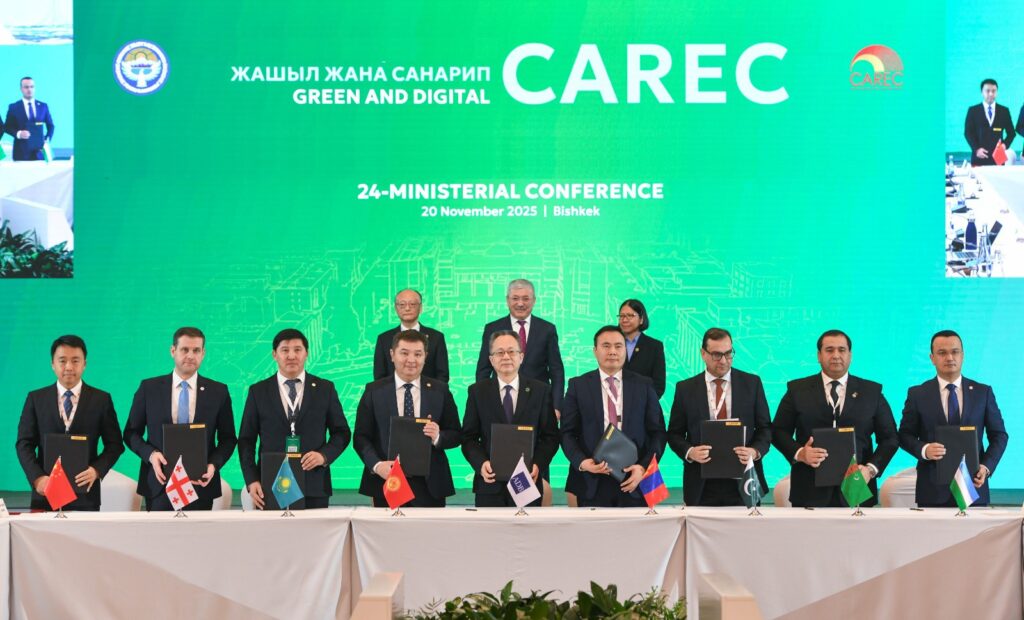
Georgia’s Deputy Minister of Economy and Sustainable Development, Genadi Arveladze, has signed a declaration to commence negotiations on the CAREC Trade and Investment Facilitation Partnership Agreement (CARTIF).
According to the Ministry of Economy, the signing took place in Bishkek, Kyrgyzstan, during the 24th CAREC Ministerial Conference.
The Ministry stated that the purpose of the declaration is to establish a modern, development-oriented partnership agreement that promotes the free flow of goods and services within the CAREC region, reduces non-tariff barriers, and fosters the growth of digital trade. The declaration also notes that negotiations for the Partnership Agreement on Trade and Investment Facilitation (CARTIF) are scheduled to begin in 2026.
Deputy Minister Arveladze welcomed the initiation of negotiations on the CARTIF agreement with CAREC member countries, emphasising its significance.
“One of the priorities of the Georgian government is to diversify export markets and establish free trade agreements that enable Georgian products and services to access as many countries as possible on preferential terms. Currently, we have free trade agreements with only a subset of CAREC countries. Therefore, cooperation under the CARTIF framework will greatly assist Georgian manufacturers in expanding their exports to more countries with preferential treatment,” he stated.
Arveladze further highlighted that CARTIF aims to facilitate trade among member nations, attract investments, and foster a more competitive market environment.
Additionally, a memorandum on the development of CAREC regional tourism was signed during the conference. Its goal is to deepen regional cooperation, enhance competitiveness, and position the CAREC region as a unified, high-value tourism destination.
The CAREC Ministerial Conference is an annual gathering of high-level representatives from participating states, where strategic plans and action programmes are approved, various initiatives are discussed, and mechanisms for project financing and other key issues are addressed.