


Badri Japaridze: GD may be preparing ground for constitutional coup by banning parties
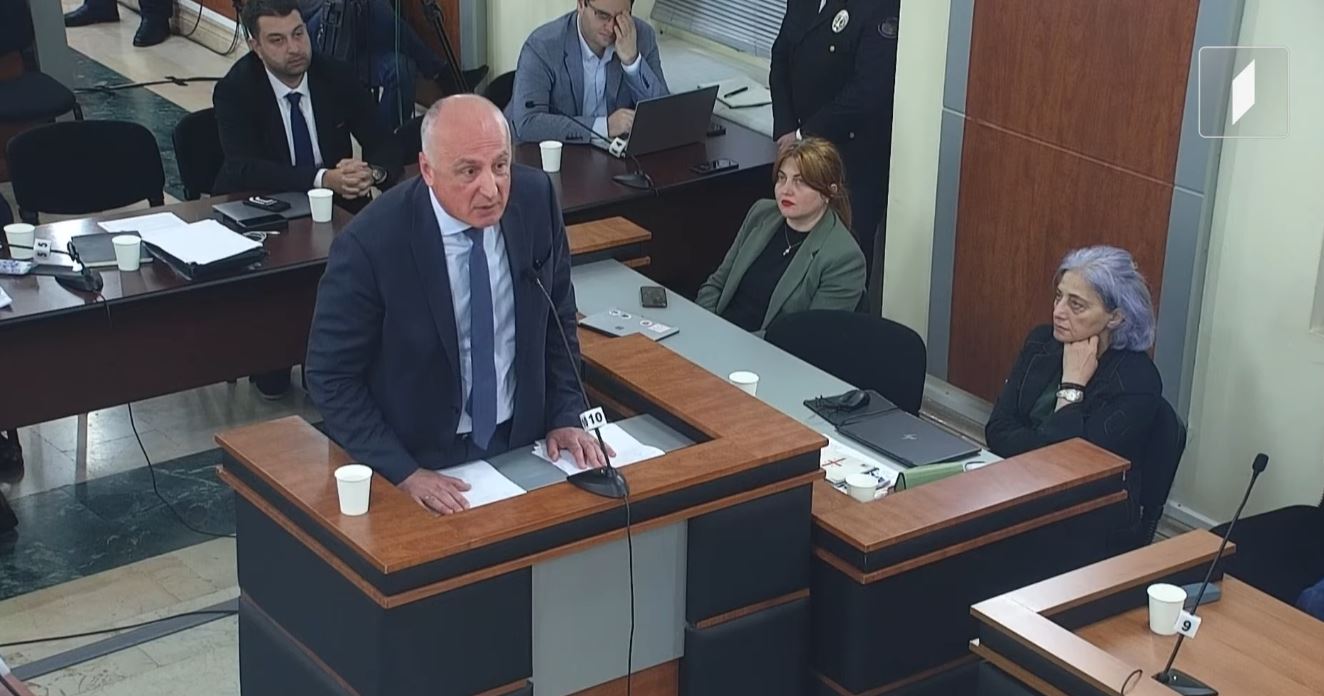
“Today, Georgian Dream is using its lawsuit to try to ban Georgia’s independent statehood, not merely several political parties. We have reason to believe that, by seeking to ban these parties, Georgian Dream is preparing the ground for a constitutional coup,” Badri Japaridze, one of the leaders of Lelo – Strong Georgia, said at the Constitutional Court.
According to Japaridze, Georgian Dream wants to deprive more than one million voters with different views of their right to choose and exclude them from elections, secure a constitutional majority and consolidate its de facto usurped power at the constitutional level.
“They want to restrict freedom of political choice and force Georgian citizens to vote not for the parties they support and which Georgian Dream intends to ban, but for the parties Georgian Dream itself favours. They want to change the country’s historical development path against the will of the Georgian people, isolate Georgia from the free world and govern the country in a Russian-style autocratic manner—through the decisions of one person, one-party rule, a subservient justice system, the deprivation of rights and repression of those who think differently, and a nation divided into hostile camps.
That is why we are here today not to defend any particular party, but to defend Georgia’s independence and freedom—to protect them from the very government that has stepped outside the bounds of the Constitution. We are here to defend the sovereignty guaranteed by the Constitution and to protect it from those in power who are driven by a desire to seize the people’s independence.
As for the demand to ban Lelo – Strong Georgia, since its establishment in December 2019, the party has consistently made strengthening Georgia’s state institutions, ensuring judicial independence, building an independent justice system and advancing the country rapidly towards European integration its primary goals. These have been our objectives from the outset, and we have devoted all our efforts to achieving them.
In response, virtually not a single day has passed without our being subjected to unjust, politically motivated criminal prosecution instigated by Georgian Dream. For the seventh year, we have spent virtually no time free from investigations, fabricated charges, court proceedings and/or prison cells,” Japaridze said.
He added that Georgian Dream was making an entirely absurd and cynical accusation against Lelo, claiming that the party had violated Georgia’s Constitution, when the reality was precisely the opposite.
“Today, Georgian Dream is making yet another completely absurd accusation against us, alleging that we violated the Constitution by not entering Parliament. And are not the representatives of the parties that did enter Parliament sitting here among those whose bans you are seeking?
As for our parliamentary mandates, as is well known, Georgian Dream itself annulled them following our statements.
I would like to address another particularly dangerous aspect of this lawsuit: Georgia’s sovereignty and territorial integrity. Beyond the demand to ban political parties, the lawsuit contains an equally serious threat. It advances the argument that Georgia itself laid the groundwork for Russia’s aggression in 2008. This is an attempt to shift responsibility from the aggressor to the victim.
If the Constitutional Court endorses this reasoning, it could establish a dangerous precedent of capitulation. If the Court upholds the lawsuit, a policy of ‘not provoking Russia’ could become a constitutional obligation. This would mean that criticism of the occupying power could be declared sabotage, provocation of Russian aggression and, consequently, unconstitutional.
It would mean that Georgia’s foreign policy and Euro-Atlantic course could be regarded as a threat, a provocation against Russia and, consequently, unconstitutional. This is an extremely dangerous game with the Constitution.
Article 78 of Georgia’s Constitution obliges state institutions to ensure the country’s European and Euro-Atlantic integration.
This is the constitutional choice of the Georgian people, not an issue whose resolution should be left to the Kremlin. That is precisely why I want the Constitutional Court to fully recognise its responsibility in this regard, so that the internationally established principle of Georgia’s territorial integrity and the non-recognition of its occupied territories is never endangered.
The Court’s ruling could become a decisive legal argument in Russia’s hands. No state institution in Georgia has the right to create such a threat, let alone enshrine it at the constitutional level.
I will conclude with the Gospel of Luke, Chapter 6, Verse 31: ‘And as ye would that men should do to you, do ye also to them likewise.’ Verse 38: ‘For with the same measure that ye mete withal it shall be measured to you again,’” Japaridze said.