


Armenian PM: Peace returned to South Caucasus; now we must focus on increasing prosperity and development
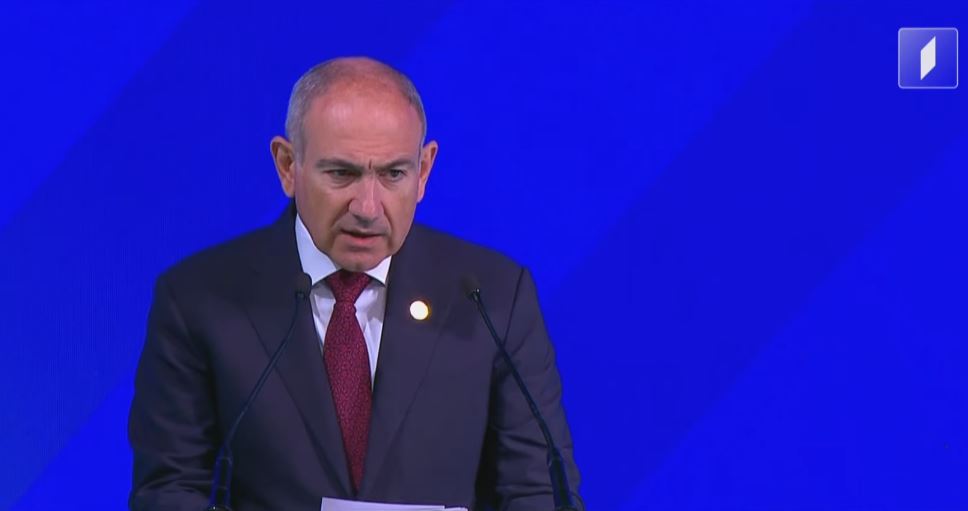
“Peace has returned to our region, and all that remains for us is to build upon it by increasing cargo turnover, expanding energy networks, developing electronic infrastructure, and fostering greater prosperity and growth. These efforts will serve to strengthen the South Caucasus further,” stated Armenian Prime Minister Nikol Pashinyan during his speech at the Tbilisi Silk Road Forum.
According to him, all three nations — Georgia, Armenia, and Azerbaijan — have the potential to boost prosperity within their borders.
“I would like to thank my colleague, the Prime Minister of Georgia, Irakli Kobakhidze, for the invitation and the opportunity to participate in this event. It is a great honour for me to participate in the international forum known as the Tbilisi Silk Road Forum for the second time. As its name suggests, this event has already established itself as an important platform for officials from various countries, representatives of the private sector, and international experts to share new ideas and collaborate.
Thanks to this platform, the peace initiative between Armenia and Azerbaijan was successfully implemented, evolving into a support mechanism endorsed by many international partners. We need to develop regional and global transport and communication links not only through Armenia, the Islamic Republic of Iran, Azerbaijan, Turkiye, and Georgia, but also by opening borders with these countries. I am pleased to confirm that we have made significant progress in this regard.
In August 2025, at the initiative of the U.S. President, a peace agreement was signed in Washington between me and the President of Azerbaijan, which was also endorsed by Donald Trump. The declaration specifically addresses regional communication, emphasising the importance of dialogue, interaction, and engagement in bilateral and international formats to ensure peace, prosperity, and stability in the region. It also affirms the principles of sovereignty and territorial integrity. The aim is to facilitate unrestricted connectivity between the Republic of Azerbaijan and the Nakhchivan Autonomous Republic through the territory of the Republic of Armenia. This represents a bilateral effort to enhance international and interstate connectivity. Azerbaijan has taken a significant step in implementing this spirit,” Pashinyan stated [The quotes were translated from Georgian language simultaneous interpretation].
According to Nikol Pashinyan, Armenia is working to institutionalise peace with Azerbaijan and to develop interstate relations.
“Azerbaijan has already begun lifting restrictions on the movement of goods through its territory to our country. President Aliyev mentioned this yesterday. I thank him for this step, for this decision, and I welcome this initiative. Several months ago, many considered this unthinkable. Goods from Kazakhstan were being imported via Georgia, bypassing these territories. These barriers were removed through the efforts of Irakli Kobakhidze and Kassym-Jomart Tokayev. I would like to thank the leaders involved in this endeavour.
In accordance with the fourth paragraph of the Washington Declaration, I wish to highlight the following key point: “The Republic of Armenia will collaborate with the United States Government and jointly designated third parties to bring the Trump route to fruition, thereby ensuring increased connectivity across Armenian territory. We are resolute in our commitment to achieving this goal and will spare no effort in doing so as quickly as possible. Our collaboration with the United States Government is already underway, with a view to implementing these agreements in their entirety.
I am also pleased to note that we have established a positive dialogue with Turkiye, which has paved the way for the opening of our border. Furthermore, I would like to confirm that we are not only politically prepared, but also technically equipped, to facilitate the transit of goods through our territory from today. I would go so far as to say that, from today, we are in a position to undertake cargo turnover across the territory of the Republic of Armenia. The necessary land and border infrastructure is already in place, utilising points such as Margara and others.
In addition, we are politically committed to ensuring transit from the Nakhichevan Autonomous Republic to the main territory of Azerbaijan, and vice versa, via the territory of Armenia. While technical issues currently prevent us from realising this vision, we are nonetheless politically ready to facilitate rail transit from the Nakhichevan Autonomous Republic.
I am confident that these technical issues will be resolved within the next two to three years, at which point we will also have established an electricity network connecting Azerbaijan to the territories of Armenia, via Nakhichevan and Turkiye. This road and electric infrastructure will be developed as part of a trilateral project, which has already become a topic of dialogue,” Pashinyan stated.
As the Armenian Prime Minister stated at the Silk Road Forum in Tbilisi, the most important achievement is that peace has been established in the South Caucasus.
“The most significant development in this regard is that peace has already been established between Azerbaijan and Armenia, based on the agreements reached at the Washington Summit. We are working to institutionalise this peace, to turn these agreements into a tangible reality, and to develop interstate relations, efforts that were initiated in Washington. Alongside this, as I mentioned, all transport routes will be gradually opened, bringing about a historic change in our region.
Ultimately, we have laid the groundwork for peace, prosperity, and development in the South Caucasus. Development will serve as the foundation for an inevitable and enduring flow of goods, the expansion of energy transmission lines, commercial cargo traffic, and railway connectivity. Peace has returned to our region, and all that remains is to build on it by increasing cargo flows, energy exchanges, electronic infrastructure, prosperity, and overall growth.
This will further strengthen the South Caucasus, consolidate peace, and accelerate progress for Armenia, Georgia, and Azerbaijan alike. I am confident that the leaders of all three countries possess the will, intelligence, and resolve necessary to ensure ongoing development, prosperity, peace, and economic growth, and, of course, through cooperation with neighbouring nations and international partners,” Pashinyan concluded.
In addition, as Nikol Pashinyan emphasised, Georgia, Armenia, and Azerbaijan should foster their relations and capitalise on the opportunities they present, ensuring stability in the region.
“I have read the comments suggesting competition between transport projects in the region, but I believe these are not rival routes; I do not agree with those views. Rather, they complement each other. They are mutually reinforcing routes that further enhance the potential of the South Caucasus.
Based on the fourth point of the Washington Declaration, the Black Sea Railway will be opened, increasing transit capacity not only for Armenia but also for Georgia and Azerbaijan.
The peace dialogue established between Armenia and Azerbaijan is a project that will normalise neighbourly relations between Georgia and the Islamic Republic of Iran, transforming the South Caucasus into the most attractive east-west route. This will lead to growth and development in infrastructure across these countries. I would also add that meeting the current international demand will not be sufficient; it is already clear that more needs to be done.
Georgia, Armenia, and Azerbaijan must develop their relations and turn them into capital, so that our region remains stable,” Pashinyan stated.