

Sabina Ćudić: All pillars of democracy is getting worse in Georgia, call upon authorities to re-establish dialogue and co-operation with PACE
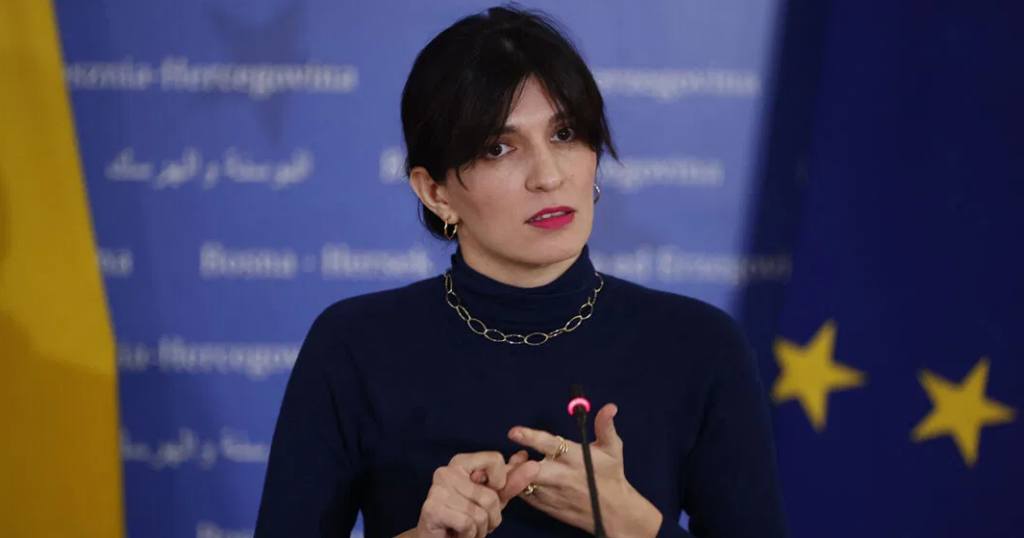
“All pillars of democracy is getting worse in Georgia. We therefore call upon the authorities to re-establish dialogue and co-operation with the Assembly and the Council of Europe. We continue to stand ready to respond,” said Sabina Ćudić, rapporteur on Georgia at the Parliamentary Assembly of the Council of Europe.
Ćudić also noted that the legislation proposed by Georgian Dream, which requires government approval for grants from foreign donors, threatens the continued existence of civil society.
“When we analyse the situation in a member state, we analyse it against the democratic standards and the pillars of democracy.
I will remind you that those pillars are: rule of law, ensuring equality and justice, based, among other things, on separation of powers, second free and fair elections, and three; protection of human rights, safeguarding individual freedoms.
If we analyse the situation in Georgia, for which we are here today, and if we analyse the time between the last time we discussed it and the adopted January resolution, and today, unfortunately we have to report that in all these pillars of democracy the situation is getting worse.
We are experiencing severe democratic backsliding in the country. I will go a little further into detail specifically addressing these pillars of democracy and how the situation on the ground is affecting all citizens of Georgia.
Building onto what my dear co-rapporteur had already covered, I will share with you some information in relation to these criteria, starting with civil society.
Hopefully I don’t need to remind you that we all consider robust civil society to be one of the key elements of a healthy democracy. The space for civil society is shrinking in Georgia in the current situation, and continues to rapidly shrink. The parliament has not repealed the law that was the subject of many discussions here on transparency of foreign influence, as it was asked to do, but replaced it with a Georgian version of a law that criminalises non-compliance with foreign agent registration.
The Committee on the Honouring of Obligations and Commitments by Member States of the Council of Europe (Monitoring Committee) has asked for an urgent opinion from the Venice Commission on this law, and we urge the authorities to fully address any concerns and recommendations that will be contained in it.
However, we are worried about the prospects for that. Only this week Georgian Dream initiated new legislation that would require that any foreign donor, and our Council of Europe is included, to ask for the authorisation of the authorities before it can make a grant to Georgia civil society organisations.
These developments – as we can, I’m sure all agree – do not just endanger civil society. It puts at risk its continued existence, which will be devastating. Again, going back to the democratic standards in the country.
Another key element of a functioning democracy is media. Similarly, the media environment has continued to deteriorate, as underscored by several reports of respected organisations, including again, our very own Council of Europe. We note, with concern, the reports of intimidation and dismissals of civil servants that have been critical of the authorities. Building on again to what my co-rapporteur said on the state of the arrests and intimidation of civil society members, I will reiterate the demands that we issued in the January resolution that we still firmly stand behind.
Lastly, and perhaps most worryingly, we outline one of our key concerns. It’s the actions taken by the authorities to ban the full spectrum of democratic opposition in the country. Banning the opposition, besides being in complete violation of the country’s obligation under the Statute of the Council of Europe, together with the dramatically shrinking space for civil society and independent media, would signal the establishment of functional autocracy in Georgia. The way we treat the opposition – and on a personal note, I come from one of the leading political parties in my country constituting a majority – the way we treat the opposition and the way we treat media and civil society is the ultimate criteria against which we measure progress of a country, or in this case, severe backsliding.
We therefore call upon the authorities to re-establish dialogue and co-operation with the Assembly and the Council of Europe. And we continue to stand ready to respond. We want to engage, as my dear co-rapporteur said, this is not the report we wish to continue delivering. The report we want to deliver is the one on progress, the one on constructive engagement with the Council of Europe, the one where we see our colleagues – both from the leading parties and the opposition, now and in the future – back here in this chamber discussing this with us,” she declared.