


The National Interest: Georgia’s strategic location, infrastructure indispensable for U.S. South Caucasus and Black Sea policies
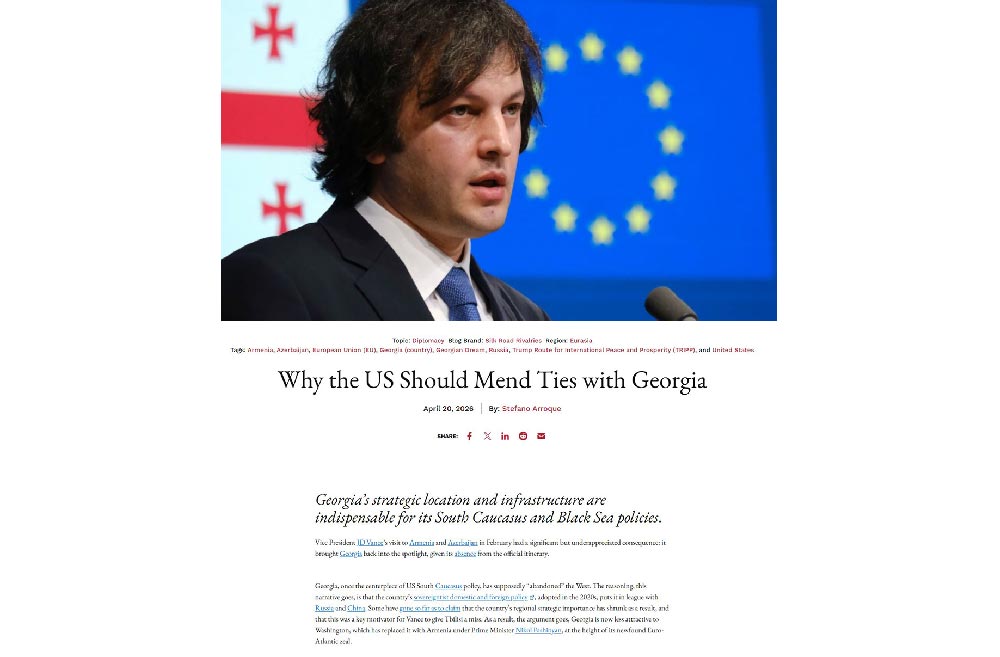
The National Interest, an award-winning online publication in the U.S., published an article titled: “Why the US Should Mend Ties with Georgia.”
The author of the article, Stefano Arroque, is a scholar of European politics researching Central and Eastern European political and cultural affairs.
Stefano Arroque says that Georgia’s strategic location and infrastructure are indispensable for the U.S. South Caucasus and Black Sea policies.
According to the article, Vice President JD Vance’s visit to Armenia and Azerbaijan in February had a significant but underappreciated consequence: it brought Georgia back into the spotlight, given its absence from the official itinerary.
“Georgia, once the centerpiece of US South Caucasus policy, has supposedly “abandoned” the West. The reasoning, this narrative goes, is that the country’s sovereigntist domestic and foreign policy, adopted in the 2020s, puts it in league with Russia and China. Some have gone so far as to claim that the country’s regional strategic importance has shrunk as a result, and that this was a key motivator for Vance to give Tbilisi a miss. As a result, the argument goes, Georgia is now less attractive to Washington, which has replaced it with Armenia under Prime Minister Nikol Pashinyan, at the height of its newfound Euro-Atlantic zeal,” it reads.
The author believes that this is a fundamentally incorrect interpretation of the situation, given that the goal of Vance’s journey was to promote the Trump Route for International Peace and Prosperity (TRIPP) project, rather than touring the South Caucasus as a whole.
“Nor did Vance’s visit, in any way, consolidate Armenia’s position as the new South Caucasian centre of gravity—a notion that would almost certainly engender a furious reaction from Azerbaijan. Nonetheless, this incorrect interpretation has gained significant ground in Europe and among certain foreign-policy circles in the United States. The limited pushback against even its most basic assumption— ie, that of a supposed pro-Russian approach by Tbilisi—has been detrimental to the elaboration of a coherent US Georgia policy,” reads the article.
“It is true that relations between the United States and Georgia, once the backbone of Washington’s South Caucasus policy, have been lukewarm at best for nearly half a decade. This is not, however, due to any lack of interest on Georgia’s part, as Tbilisi’s repeated overtures to the Trump administration, formal and otherwise, have demonstrated. Nor is it caused by any supposed rapprochement with Moscow, which has been and remains a political and military red line for any Georgian government, despite what is repeated, often in hyperventilating tones, in Western and local opposition-leaning media outlets.”
In this context, the author of the article recalls the May 2025 open letter of Georgian Prime Minister Irakli Kobakhidze to President Donald Trump and Vice President JD Vance “emphasizing the programmatic similarities between the Georgian government and the latter’s administration.”
“In this letter, Kobakhidze complained to Trump about his administration’s treatment of Georgia, notwithstanding their political closeness and the common challenges faced by Tbilisi and Washington alike with non-governmental and international actors. From a Georgian political perspective, the letter’s contents were logical. The undoing of US-Georgian ties came from Washington, not Tbilisi, and has taken place despite Trump and his cabinet,” the article reads.
According to Stefano Arroque writes that in Washington and Brussels, antagonism towards Georgia is framed around its supposed ties to Russia and Iran, which are variously attributed to the state, the ruling party, or specific leaders within it. In Europe, and especially in Brussels, diplomats and politicians alike are more open about their motivations: Tbilisi’s opposition to liberal Western diktats on Ukraine, social issues — including LGBT policies — and the role of NGOs in domestic politics.
“As a result, Georgia has come under increased financial and political pressure from Brussels. Over the past few months alone, the European Union (EU) has repeatedly tried to impose sanctions on Georgia, though Hungary and Slovakia have thus far vetoed all its efforts. In its most recent sanctions package, Brussels went so far as to propose sanctioning strategic infrastructure, such as the Port of Kulevi, which the Azerbaijani state-owned oil giant SOCAR uses for its Black Sea operations.
The EU has similarly suspended visa-free travel rights for “holders of Georgian diplomatic, service, and official passports” as a response to alleged “democratic backsliding” and other shortcomings in Tbilisi. These accusations ring hollow given the broadly positive assessment of Georgia by international institutions. The IMF, for example, praised the country last year for its sustained economic growth amid geopolitical challenges. Similarly, in terms of economic freedom, Georgia is ranked ahead of 17 EU Member States,” the article reads.
The author believes that in Washington, similar attempts have been made by the informal coalition of Georgia hawks, whose best-known spokesman is Rep. Joe Wilson (R-SC).
“Wilson has sponsored the MEGOBARI Act, a bill proposing heavy sanctions on key Georgian government officials. The bill, approved in the House of Representatives, was stalled in the Senate by Majority Leader John Thune (R-SD).”
Taking all this into account, Stefano Arroque declares that for the United States, “mending ties with Georgia is the most sensible political choice.”
“Georgia, in terms of policies and political programs, is the most closely aligned country in Central and Eastern Europe with the Trump administration’s ideological position. The case for renewing the US-Georgia alliance was made all the stronger by the administration’s 2025 National Security Strategy (NSS), which signals a shift away from an axiomatic vision of the liberal international order towards a “civilizational” approach to foreign policymaking,” reads the article.