


Tbilisi hosts 11th Green Energy Corridor ministerial with Georgia, Azerbaijan, Romania and Hungary
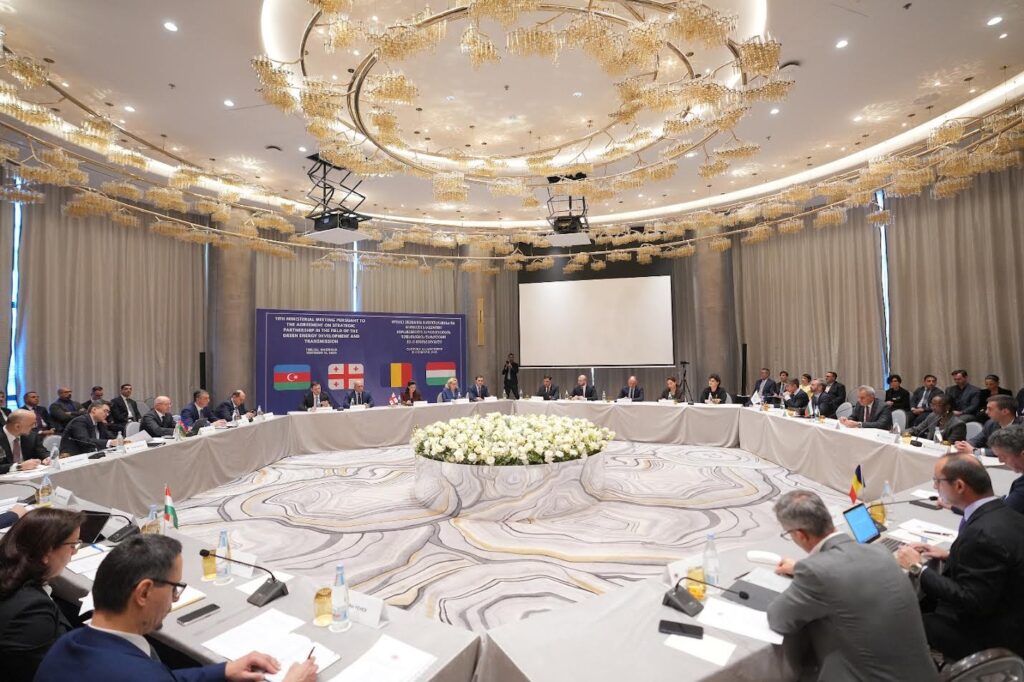
“We are creating one of the most ambitious, forward-looking frameworks for energy cooperation both in our region and beyond, and this is a symbol of how strategic partnership and sectoral integration can promote political and economic cooperation,” Minister of Economy and Sustainable Development Mariam Kvrivishvili stated at the 11th ministerial, hosted by Tbilisi within the framework of the “Strategic Partnership in the Development and Transmission of Green Energy” agreement between the governments of Georgia, Azerbaijan, Romania and Hungary.
Azerbaijan’s Minister of Energy Parviz Shahbazov, Hungarian State Secretary for Foreign Affairs and Trade Boglarka Illés and Romanian State Secretary for Energy Cristian Busoi participated in the ministerial alongside Mariam Kvrivishvili.
As Mariam Kvrivishvili observed, the Georgian government aims to ensure the country’s energy independence and security. She considers the ministerial to be a vital platform for the shared vision of the four partner nations, fostering a connected, sustainable, and energy-secure future.
“This project is not limited merely to infrastructure construction, it is the foundation for energy independence and long-term sustainability, creating a new, clean energy transmission route between the South Caucasus and Europe, which will be mutually reinforcing for energy security through the diversification of supply sources and will also strengthen the region’s strategic importance for wider Europe,” Georgia’s Minister of Economy and Sustainable Development noted.
At the 11th ministerial meeting, the parties discussed the future coordination of the submarine cable and green corridor projects, as well as the activity report of the joint venture established under the framework of the agreement.
According to the press service of Georgia’s Ministry of Economy and Sustainable Development, during the event, Zviad Gachechiladze, a member of the Board of Directors of Georgian State Electrosystem, delivered a briefing on the progress of the Black Sea submarine cable project. He discussed the conclusions of the technical-economic study, which confirmed that the project is both attractive and feasible. It was also noted that the project has been incorporated into the European Network of Transmission System Operators for Electricity (ENTSO-E)’s ten-year development plan, as well as into the pre-selected list of Projects of Mutual Interest (PMI) by the European Commission.
The Ministry of Economy furthermore stated that the Tbilisi ministerial was attended by the Ambassadors of Azerbaijan, Romania, and Hungary, as well as representatives from Georgia’s Ministry of Foreign Affairs, the Georgian State Electrosystem, and the transmission system operators of Romania, Azerbaijan, and Hungary. Additionally, representatives from the World Bank and the Asian Development Bank were present.