


PM Kobakhidze: We will not tolerate violence against Georgia from inside or outside
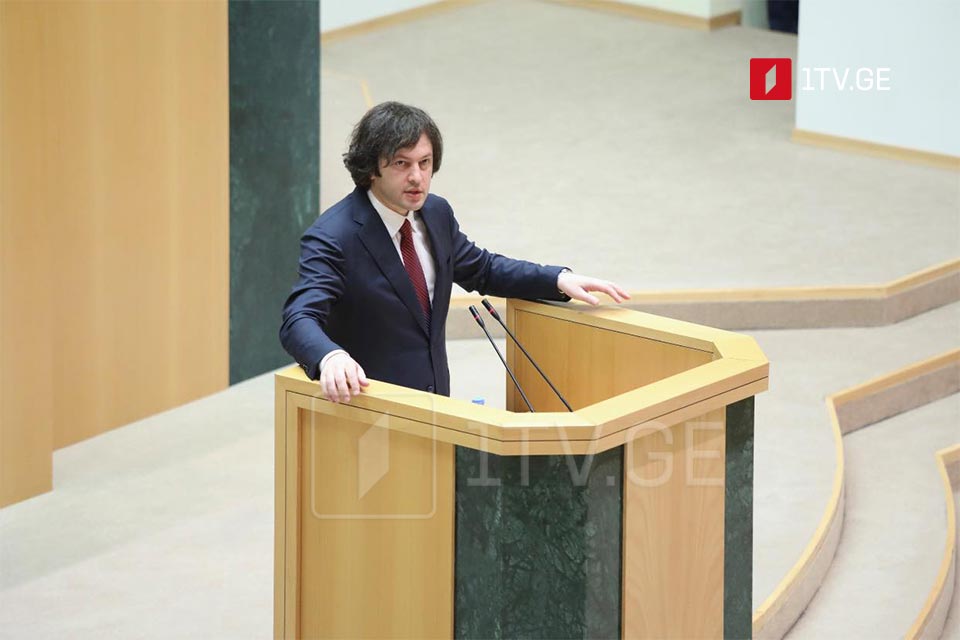
“Amidst ongoing external turbulence, some individuals believed that the Georgian state had been weakened and decided to perpetrate acts of violence against it. The events of November and December serve as stark manifestations of this belief. For reasons unknown, many actors appeared to be too bold against our state,” said Irakli Kobakhidze, Prime Minister of Georgia, during his annual address to Parliament.
According to Kobakhidze, the Georgian government will firmly oppose any form of arbitrariness and violence directed at the nation—whether originating from within the country or from external forces.
“I would like to address a significant issue. Amidst ongoing external turbulence, some individuals believed that the Georgian state had been weakened and decided to perpetrate acts of violence against it. The events of November and December serve as stark manifestations of this belief. For reasons unknown, many actors appeared to be too bold against our state. We observed attempts—financed discreetly from abroad—to undermine our institutions, tarnish the reputation of our church, finance LGBT propaganda, and manipulate political rallies—all conducted covertly, away from the eyes of our citizens. They believed they could get away with this, thinking it was all possible without repercussions.
You may recall, for instance, the blatant interference in the independence of our judiciary. Several instances of meddling come to mind, but I would like to highlight a specific case: a judge within our justice system was summoned to an embassy, where a representative demanded a report on a particular case. This act directly violated the Constitution of Georgia and the Vienna Convention and trampled all principles of law and diplomatic protocol.
Subsequently, you may remember that the Strasbourg Court also issued a ruling on this case, affirming the fairness of the Georgian judge’s decision from start to finish—yet, no apologies were issued. Some believed they could treat the Georgian state with such disdain, assuming it was weak and that our sovereignty, especially the independence of our judiciary, could be so flagrantly undermined.
There were also attempts to influence legislation from abroad. Just a few years ago, foreign diplomats—who should have had no involvement in our legislative process—sat at the table with us, drafting and imposing laws upon Georgia. Some misguided individuals thought the state was too fragile to resist external pressure.
Furthermore, I remember external actors dictating who should remain in key positions, such as the Minister of Internal Affairs. During that period, there were incidents where police officers were insulted or even slapped—acts that should have been unacceptable. Some believed it was permissible to refuse recognition of election results, to block Parliament from convening, and, on that basis, to negotiate and sign unconstitutional agreements. They assumed the state was too weak to defend itself.
Some believed that when constructing a strategically vital hydroelectric power station, intervention from outsiders could prevent its completion. Foreigners and even some Georgians believed that the state lacked the strength to resist external influence and thought they could confront and weaken it.
Today, however, we face a completely new reality. Under no circumstances will we allow arbitrariness or violence against the Georgian state—neither from within nor from outside,” Irakli Kobakhidze declared.