


Parliament Speaker: ‘Protest day 666’ marks opposition’s shift into ‘pseudo-religious sect’
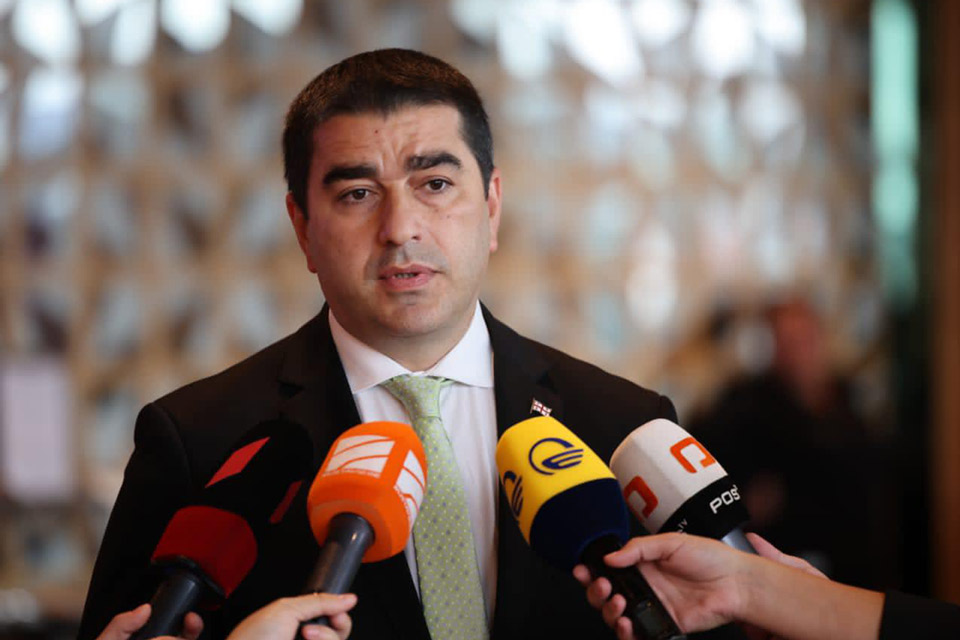
“Almost 700 days, 100 weeks, have passed since the 2024 parliamentary elections. The elections, which a section of the opposition declared a referendum, did not yield their desired outcome. After refusing to recognise the results, another wave of street politics followed, later marketed as a “continuous protest,” Speaker of Parliament Shalva Papuashvili wrote on social media.
“According to the opposition calendar, today marks Day 666 of the ‘protest.’ This milestone date provides a good opportunity to thoroughly describe how a group of political protest activists transformed into a pseudo-religious movement, and how what appeared to be a conventional campaign became an aggressive community with its own rituals, symbols, calendar, and internal moral order—a pseudo-religious fundamentalist sect.
A prolonged protest in itself does not signify sectarianism. The turning point occurs when the movement refuses to acknowledge its errors, brands dissent as treason, and responds to failure by demanding unconditional loyalty.
When a political movement can no longer justify its existence through tangible results, it faces a clear choice: review its trajectory, adapt its tactics, reset its objectives, or bring the campaign to an end. Yet one more option exists: declaring protraction itself a success. At that stage, rallies, marches, and symbolic actions gradually turn into ends in themselves, based on the principle: ‘We continue, therefore we exist.’
Herein lies the issue that has emerged within the Rustaveli protests: form is gradually stripped of its original substance and becomes the substance itself, while performing the ritual becomes the primary purpose of participation.
This is precisely where the traits of a pseudo-religious transformation become clear:
1. Sacred Space
A religious community possesses a location where ordinary space takes on special significance. In the ‘continuous protest,’ Rustaveli Avenue and the area surrounding Parliament serve this role. The ritual repetition of gatherings transforms this site into a symbol of collective identity. Attending Rustaveli is no longer merely an expression of a political demand; it affirms belonging: ‘I am here, therefore I am one of you.’ Congregation members gather in a house of worship; protest participants gather beneath the Parliament arches.
2. Political Liturgy
Rituals require repetition. Set hours, fixed routes, marches, chanting, flags, music, arriving at Parliament, and dispersing form an almost liturgical cycle. The true product of a ritual is not always a shift in government decision-making; it can be the re-creation, reinforcement, and affirmation of the group’s existence. A mechanism of guilt is also deployed: straying from the ritual is viewed as a betrayal, a burden of sin calling for penitence and return.
3. Its Own Calendar
Established communities have dates that periodically reactivate group memory. In the Tbilisi protests, the political calendar has been filled with special days: the protest start date, days of arrests, anniversaries, and other milestone numbers. This calendar enables the movement to construct its own historical timeline. Political events evolve, yet the ritual continues counting time. The flaw emerges when the date itself becomes the main reason to meet, ignoring what the gathering is actually supposed to deliver. A closed loop takes over: a new milestone, fresh expectations, and endless preparation for the next date.
4. Martyrs
A ritualised movement requires martyrs. Consequently, an individual who is arrested, injured, resigns from employment, or pays another personal price naturally becomes an essential component of the movement’s memory. A political problem begins when losses suffered are declared proof of the movement’s absolute righteousness. Initially, the logic runs: ‘We fight, and therefore we have victims.’ Then a substitution occurs: ‘Because we have victims, our fight must be righteous.’ This substitution marks the start of sacralising heroes. Prisoners’ letters are read, their names recited, and portraits painted. A hierarchy forms within this symbolic world: some are rank-and-file heroes, while others become the sect’s main martyrs. The initial context surrounding these detentions has long been lost; today, their incarceration has become the context itself. This is precisely why the movement depends on having prisoners above all else—to uphold the very premise of its ongoing existence.
5. Symbols
A flag, song, photo, or slogan is a standard element of political communication. However, under conditions of repeated ritual, they assume a different function. A specialised iconography emerges—visual and acoustic signs whose use extends beyond conveying information to signal group membership. Waving a flag or chanting no longer merely expresses what a person demands; it signals to whom that person belongs.
6. Prophecy
Sustained mobilisation requires a promise of the future: ‘Victory is near,’ ‘Just a bit longer,’ ‘One more big gathering,’ ‘It will work, but it won’t work without you,’ ‘In the end we will win,’ ‘To the very end.’ Time passes, and the promised breakthrough fails to materialise. A new date arrives, followed by another. At this stage, a group could re-examine its assumptions, but it can also defer victory once more. In the latter case, the prediction increasingly resembles false prophecy: it avoids verification, while its failure to materialise is declared a fresh test of faith.
7. Dogma
A political position is subject to deliberation: tactics change, demands are refined, and compromises are reached—standard development in politics. In a dogmatic system, the opposite principle applies. The dogma’s primary trait is that facts cannot directly invalidate it. As a result, all questions of substance vanish. Any political debate shifts into moral categories, leaving only one question: ‘Which side are you on?’ This explains why, within the dogmas of this pseudo-religious sect, the European Union is the ‘Promised Land,’ Article 78 is the creed, resolutions are commandments, and foreign politicians are high priests endowed with infallibility. In doing so, fundamental political issues are converted into symbols of faith, replacing critical discussion with an insistence on absolute compliance.
8. Final Transformation
Every doctrine, whether religious or pseudo-religious, requires territory, living space, and scale. In Georgia’s case, no vacant space exists—we have a state, society, church, morality, identity, order, and culture. Claiming universality, the sect attacked all these pillars to secure living space, establishing a parallel state and a false president, preaching a new morality to society, replacing faith with a fabricated ideology, and ordaining visiting foreign politicians as local high priests. Yet despite all efforts, it has been unable to expand beyond Rustaveli, whether real or virtual,” Papuashvili stated.
A political movement exists to bring about change, Papuashvili added, “however, once ritualised, the process changes. Where a group previously existed for a purpose, the purpose begins to justify the existence of the group.”
“At this stage, ritualisation has provided this group of people with a social environment, a collective identity, daily rituals, a sense of moral purpose, victims, symbols, special dates, and designated enemies.
Consequently, the failure to secure its political objectives does not automatically trigger the group’s collapse. For a participant, ending the process would mean not merely concluding a specific political campaign, but losing the social environment, identity, daily ritual, and moral purpose that the process added to their life.
Here lies the most exact parallel with a pseudo-religious community: the movement is no longer merely a vehicle for changing the outside world; it becomes a self-contained social realm that generates meaning for its members.
When results no longer justify the process, the process must begin to justify itself. Ritual is the primary vehicle for this shift; once sustaining the ritual becomes the sole purpose, the political movement degenerates into a closed, pseudo-religious sect.
Today on Rustaveli, on Day 666 of their calendar, we observe this precise combination of traits.
Hundreds of days remain until 28 October 2028. Most of today’s prisoners will simply serve their sentences and be released, where they will find a sect named after them and see themselves depicted on icons.
Even then, a personal choice will remain for these individuals—to resume life as members of a normal society where differing opinions and views are the norm, or to bind their identity once more to the same movement and its rituals that condemned them to martyrdom in prison.
However, this issue extends beyond those individuals. Owing to this transformation, the process launched by this group has ceased to be a genuine political struggle, marking the total bankruptcy of an idea.
Therefore, ‘continuity’ is no longer a temporal term. It has become a doctrine of a pseudo-religious fundamentalist sect.