


Papuashvili: Armaz Akhvlediani is a prominent radical; no one on earth can argue that funding radicals promotes civic dialogue
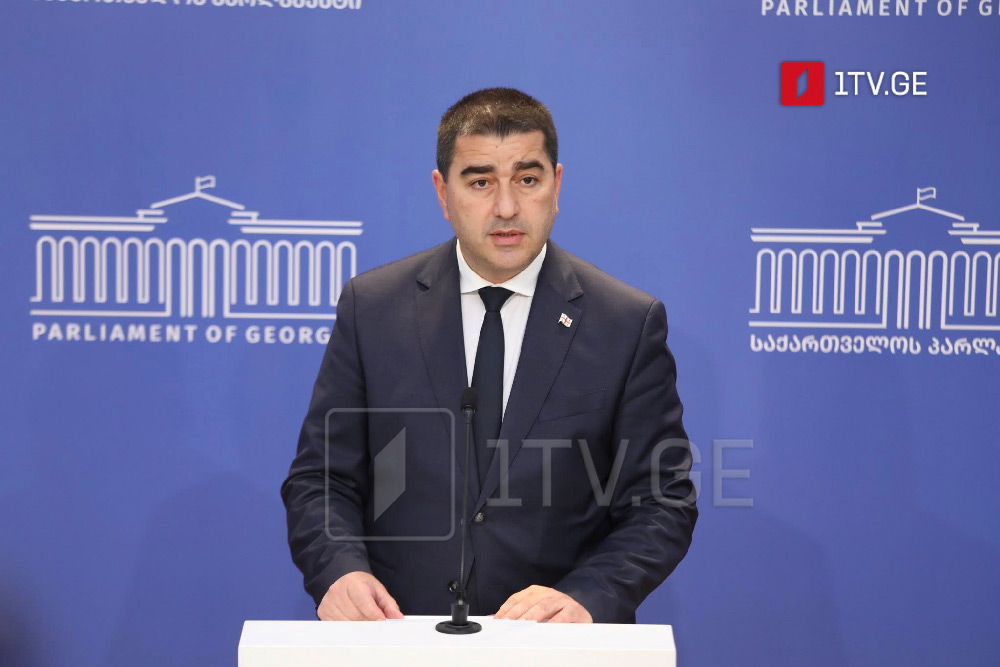
“It will be a major scandal if the Council of Europe is found to be involved in breaching national legislation in a member state,” Speaker Shalva Papuashvili stated, reacting to reports that an educational seminar organised by Armaz Akhvlediani and funded by the Council of Europe was held in Bakhmaro, with EU Ambassador Paweł Herczyński in attendance.
Organisers reportedly failed to request government authorisation for the event’s funding, potentially violating national grant legislation.
Commenting on the matter, Papuashvili stressed that Akhvlediani is a “prominent radical politician,” arguing that no one could credibly claim that funding a radical promotes civic dialogue.
“This story has two dimensions. The first is whether the law was breached, and the Audit Office will answer this question. Naturally, it will be a major scandal if the Council of Europe turns out to be implicated in violating a member state’s legislation. So let us see what conclusions the State Audit Office reaches,” Papuashvili noted.
“There is, however, a second dimension—one that may be even more scandalous. It requires no proof that Armaz Akhvlediani is a prominent radical politician. In the previous 2020 parliament, he served as an MP on the party list of a branch of the United National Movement (UNM). He refused to recognise the 2020 election results, taking months before finally entering Parliament and respecting the choice of Georgian citizens. Subsequently, in the 2024 elections, he was again included on the UNM party list, only to withdraw his parliamentary mandate following a joint decision with the UNM. He was among the very first to call for non-recognition of the 26 October election results and to advocate for radicalisation.
So the question is simple, though to tell you the truth, an answer is hardly necessary. When someone stands on the party list of the dictator Saakashvili’s UNM, rejects democratic elections, and then receives funding under the guise of ‘contributing to civic dialogue,’ it is either self-deception on the part of the Council of Europe or throwing dust in the eyes of the Georgian public. The Council of Europe can choose which of these two answers applies. There is no third option, because no one on the face of the earth can argue that funding a radical fosters civic dialogue. It is deeply regrettable to witness such developments,” Papuashvili concluded.
The State Audit Office of Georgia has initiated an inquiry into the alleged receipt of an unapproved grant by the Tbilisi School of Political Studies, headed by Armaz Akhvlediani. In an official statement, the auditing body affirmed that it will act within the full scope of its statutory powers under Georgian legislation, including the Law on Grants, to conduct a comprehensive review of the matter.
Meanwhile, the Council of Europe clarified its position in a statement carried by several media outlets. The organization emphasized that “within the framework of the seminar, which is implemented and supported directly by the Council of Europe, no grant transfer was made to a Georgian recipient.” The Council of Europe Press Division further confirmed that no honoraria or fees were paid to Armaz Akhvlediani or any other representatives of the Tbilisi School of Political Studies.