


OECD’s Andreas Schleicher praises Georgia’s PISA progress: Georgia is among the few nations to advance across science, reading, and maths
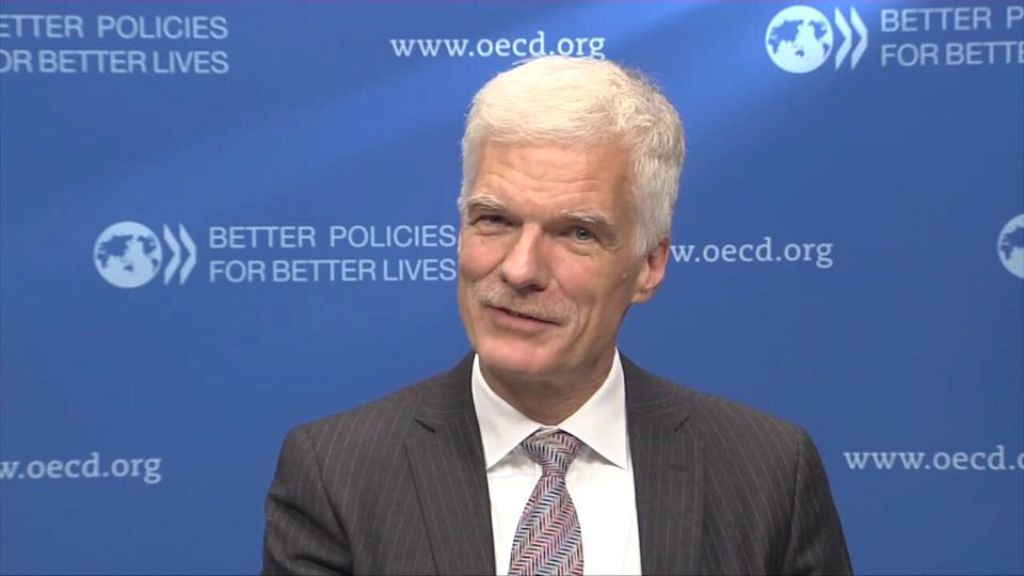
Andreas Schleicher, Director for Education and Skills at the Organisation for Economic Co-operation and Development (OECD), has responded to the latest PISA assessment findings, holding up Georgia’s academic progress as an example for other nations to follow.
Schleicher emphasised the broader significance of the results, congratulating Georgian teachers and school directors.
“The results you have achieved in the latest cycle of the OECD PISA assessment are not merely good news for Georgia; they represent a narrative that other countries ought to pay close attention to. At a time when many education systems are grappling with severe headwinds, Georgia is moving forward.
Georgia stands among a select few nations that have improved student outcomes across all three domain areas evaluated by PISA since 2022: science, reading, and mathematics. The gains in science and mathematics are particularly striking, marking Georgia’s highest scores since joining PISA in 2010. This tells us something profound; it is not simply a good news story. We are witnessing tangible progress in Georgia’s school system, and that carries enormous weight: the classrooms you shape today will become the society, economy, and democracy of tomorrow. Education remains the ultimate determinant of a nation’s destiny,” Schleicher stated.
He noted that Georgia’s pupils today will become tomorrow’s engineers, entrepreneurs, doctors, researchers, teachers, and public servants, founding businesses, solving complex challenges, strengthening communities, and shaping the institutions upon which the country’s future relies.
“Georgian teachers should take immense pride in the fact that eight out of ten students reported that their teachers take a genuine interest in their individual progress. This matters deeply, as PISA research consistently shows that pupils learn best when teachers know them well, care about their career aspirations, and stand by them along the way. PISA data also reveals that many Georgian pupils possess strong self-efficacy; they take ownership of their learning, set goals, and actively chart their own course: all vital components for navigating modern life,” he added.
Schleicher observed that in many nations, the quality of schooling a child receives remains heavily dictated by the circumstances of their birth.
“Another noteworthy aspect of Georgia’s progress is that it demonstrates quality and equity need not be competing priorities. In many countries, the school a child attends is still largely determined by the family into which they were born. Georgia presents a different picture. Between 2015 and 2022, gains among socio-economically disadvantaged pupils have driven a substantial share of Georgia’s progress. Tackling educational inequality remains a core priority in Georgia, and the results are clear.
PISA shows that Georgian pupils are highly active users of digital technology, including artificial intelligence. Georgian teachers deserve credit for helping young people navigate this new landscape. The government’s decision to prioritise equipping schools with modern technology represents a crucial investment in the future.
However, one critical challenge remains: schools cannot address all challenges alone. It would be naive to expect schools to compensate entirely for what a pupil’s family environment fails to provide. We must think carefully about how to engage parents more deeply in the learning process as true partners. PISA demonstrates that parental support is strongly linked to improved learning outcomes. Support does not mean parents must tutor their children in mathematics every evening; the most powerful form of support is far simpler: children must feel that what they do at school matters to their parents. Parents must take an interest in what their children are learning and listen to them. This is an area where Georgia still has work to do.
Georgia has achieved remarkable progress, but much work remains. We must press ahead: faster, further, and in a way that ensures no child is left behind. Georgia’s most precious natural resource is the talent, creativity, and potential present in its classrooms today. Georgia must do everything in its power to cultivate this resource, for it is what will define the country’s future,” the OECD Director concluded.
According to the Ministry of Education, Science and Youth of Georgia, findings from the 2025 PISA cycle confirm that Georgia improved performance across all primary domains compared to 2022, securing its best results in mathematics and science in a decade.