


Legal Affairs Committee backs amendment to Law on Grants
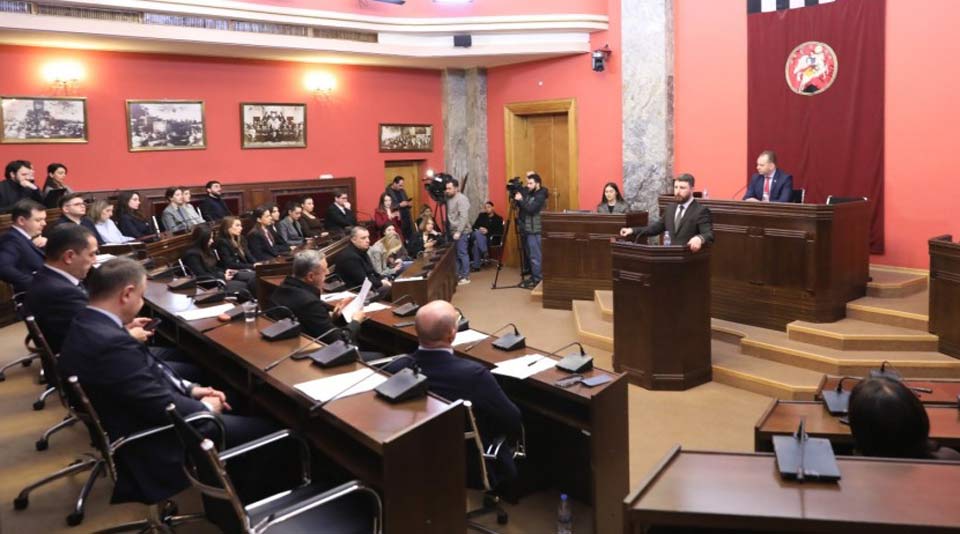
The Legal Affairs Committee reviewed, in the first reading, and supported the amendment to the Law of Georgia “On Grants,” as well as other draft laws included in the legislative package submitted by the Georgian Dream faction through the legislative initiative procedure, the Parliament reported.
According to the Parliament, the legislative amendments clarify the definition of a grant and stipulate that a grant shall imply funds transferred in monetary or in-kind form which are used, or may be used, with the belief or intent to exert influence on the Government of Georgia, state institutions, or any segment of society, through activities carried out or to be carried out that are aimed at the formation, implementation, or modification of Georgia’s domestic or foreign policy, as well as funds used, or that may be used, for activities deriving from the political or public interests, approaches, or relations of a foreign government or a foreign political party.
As the reporter, Chair of the Legal Affairs Committee Archil Gorduladze stated, an organization registered abroad, but whose activities are substantially related to Georgia and issues connected with Georgia, will be obliged to obtain the appropriate consent from the Government prior to receiving a grant, in accordance with the procedures established by the Law “On Grants.”
The amendments further define that a grant shall also imply funds transferred in monetary or in-kind form in exchange for which the grant recipient provides technical assistance in the form of sharing technologies, specialized knowledge, skills, expertise, services, and/or other types of assistance.
According to Archil Gorduladze, the Criminal Code will be supplemented with a provision under which funds paid abroad for lobbying or political activities will entail criminal liability.
“Speaking on behalf of Georgia on issues related to Georgia is solely the authority and prerogative of the Government of Georgia. Even the President of Georgia requires the consent of the Government when appearing on the international stage,” – the Committee Chair stated.
Under the legislative package, the concept of a party-political objective is clarified, and natural or legal persons that have a declared party-political objective will be subject to the same regulations as political parties.
This includes a prohibition on receiving income from abroad, a ban on donations from legal entities, and the obligation to declare income within the timeframe established by law. According to the planned amendment to the Organic Law “On Citizens’ Political Union,” a person who is employed under a labor contract by an organization whose more than 20% of annual income is derived from a foreign source will be prohibited from membership in a political party for a period of eight years.
The legislative package also envisages amendments to the Code of Administrative Offences, introducing a new administrative offence for a business entity engaging in public political activity that is not related to its primary business activity. In the event of such an offence, the business entity will be fined GEL 20,000, and in the case of repeated or subsequent offences, GEL 40,000.
The Committee took into account Archil Gorduladze’s proposal that, during the second reading of the draft law, an amendment be introduced whereby the first instance of a business entity engaging in public political activity unrelated to its primary business activity will result in administrative liability, while repeated and subsequent instances will entail criminal liability.