


Investigative Commission Chair: UNM came to power through coup, rigged elections
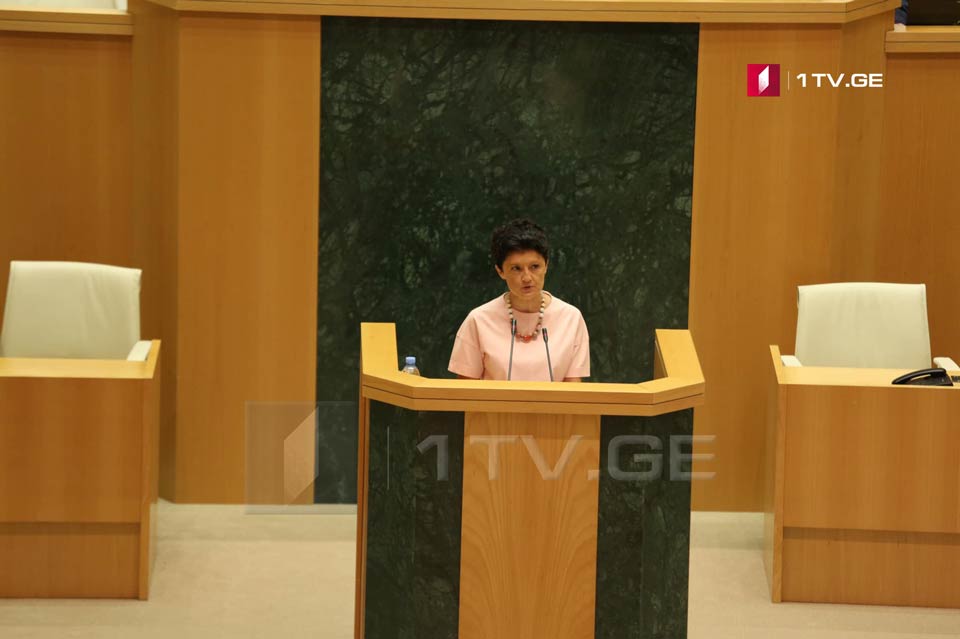
“It is becoming clear that the United National Movement came to power as a result of events that were falsely called a revolution. We are investigating this and will likely state in the commission’s conclusion that this was not a velvet revolution but a state coup wrapped in the form of a velvet revolution,” Georgian Parliament member and Chairman of Parliament’s Temporary Investigative Commission Tea Tsulukiani declared during her speech at the plenary session.
According to Tsulukiani, “the conclusion will show that a harmful force came to power through a coup and rigged elections.”
“Certain directions have emerged that, in our view, warrant careful reflection in the conclusion. Let me provide two examples. As the documented evidence indicates, the UNM came to power as a result of events that were falsely labelled a revolution. We are currently investigating this and are likely to conclude that it was not a velvet revolution—rather, it was a state coup cloaked in the guise of a velvet revolution. Subsequently, in the months that followed, when elections became necessary, they seized power through rigged elections. The Strasbourg Court has addressed this issue as well.
At that time, Chiaberashvili was heading the Central Election Commission. This issue has arisen, and we believe it will be addressed in the introduction of the conclusion—specifically, regarding who came to power and how. Of course, since we do not have your explicit mandate to explore this in full detail, this area cannot be thoroughly investigated at this stage. Parliament has assigned us other topics to study; however, in the introductory section—where the question of who came to power and by what means will be posed—we will present this properly. It will be demonstrated that a harmful force came to power, with an explanation of what that entails: it happened through a coup and rigged elections. As our work is still ongoing, I speak cautiously. These will not be empty assessments—they will be concise, concrete, and supported by documents in the introduction,” stated Tea Tsulukiani.
According to Tea Tsulukiani, a second issue has emerged and will likely appear in the introductory part of the commission’s conclusion – that the United National Movement government “was an anti-Georgian regime.”
“The second issue that has emerged, which we will also address in the introductory part, as we have not received a mandate from Parliament to investigate it in full, is that, among other findings, this was clearly an anti-Georgian regime. This conclusion is strongly supported by the results of our investigation. We are currently examining old newspaper articles and decisions that aimed at creating a ‘new Georgian,’ which essentially contributed to the degeneration of our nation. The education system of that era played a significant role, especially through the use of classified textbooks. We have now requested copies of these from the Ministry of Education, particularly those related to Georgian history, language, and literature. How Georgian history and language, elements that once constituted the mother tongue, were taught has been completely transformed, further illustrating this process.
Of course, we cannot explore this topic in the same depth as others we are working on, but these perspectives have naturally emerged. Since they have, we would like to present them for your consideration. This will be addressed in the introduction—specifically, to characterize the regime and explain who came to power and how. The entire conclusion will then focus on what they did after assuming power. The final message of the conclusion will emphasize what actions we should take now, especially considering that they caused harm not only while in office but continued to do so even while in opposition,” stated Tea Tsulukiani.