


Imedi TV owner testifies: complete media suppression was essential for Saakashvili’s actions in August 2008
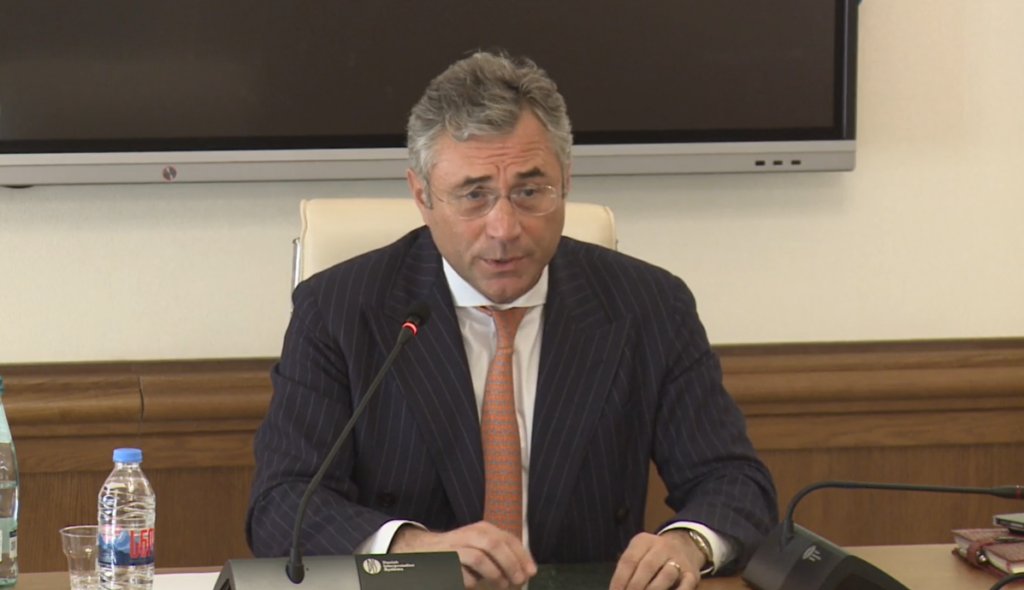
“Complete suppression of free speech has occurred in Georgia. This suppression is essential to do whatever you want in the country, as Saakashvili did. To establish absolute lawlessness, first and foremost, you must destroy free speech,” stated Irakli Rukhadze, owner of Imedi TV, during a session of the Temporary Investigative Commission on the Activities of the Regime and Political Officials from 2003-2012.
According to Rukhadze, Saakashvili would not have been able to act as he did if free speech had been preserved.
“If Saakashvili had not shut down Imedi, he could not have achieved or carried out what he did in August 2008, nor the events of May 26 [2011], and everything else that followed. Only complete control over the media grants the government this power. Without total media domination, I am convinced he could not have managed these actions,” Rukhadze emphasised.
During the commission session, Rukhadze also recalled the 2007 raid on Imedi Television.
He explained that during the raid, most photographic evidence was taken by the American general director at the TV station at the time, whose phone was not confiscated solely because he was American.
“We had an American general director, a partnership with News Corp, Murdoch’s company, which later played a crucial role in helping us regain Imedi and actively participated in the process. Apparently, they didn’t dare seize this man’s phone, following the logic that you can oppress a Georgian but not an American. They confiscated the phones of everyone else, but he discreetly took numerous photos. We later used these images as evidence in lawsuits against the Georgian government,” Rukhadze recounted.
Irakli Rukhadze also shared his impressions upon finally entering the Imedi TV station after the raid.
“Murdoch quit Imedi, but while he was still involved, we managed to gain access. I remember many ambassadors from different countries being present. I believe Giorgi Targamadze, Sozar [Subari], and Murdoch’s representative were there too. I don’t recall the exact date, but I marked December 18 as the day of our return, so it was sometime between November 7 and December 18. We were stunned upon entering because the equipment was intact. We knew from previous reports that equipment had been smashed or broken, but suddenly it was all in place. I touched one piece, turned it around, and saw a sticker on the back saying ‘Rustavi 2.’ Then I found another with a sticker saying ‘Public Broadcaster.’ They had taken equipment from these stations, brought it into the station, and placed it there, labelling each piece to indicate its origin.
This meant Rustavi 2 wasn’t a private company either. Imagine someone coming to your private business and removing equipment to use elsewhere. If they came to Imedi today, if Georgian Dream approached and told us to take the equipment and relocate it somewhere, we would simply ask: what exactly should be taken, and where should it go? This was the kind of country we lived in. Neither Rustavi 2 nor Imedi were a truly private television station. I reclaimed Imedi without even seeing its owner, simply by receiving the key in the morning. Negotiations were ongoing with Gigi Ugulava, who was rushing back and forth to Saakashvili, and as soon as we reached an agreement, Imedi was returned to us,” Irakli Rukhadze explained.
The Temporary Investigative Commission is currently examining potential systemic crimes committed by the previous government between 2003 and 2012 and is preparing a comprehensive report.