


Health Minister: No cure exists for Duchenne muscular dystrophy, only drugs that may slow its progression
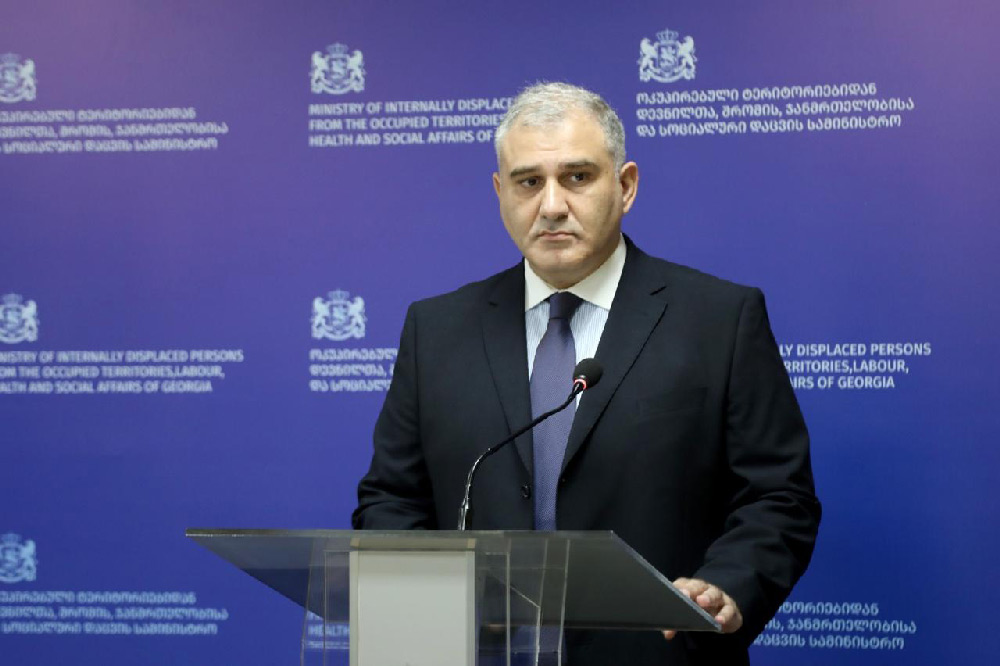
“Duchenne muscular dystrophy has long been a priority concern for the Ministry of Health. Work is ongoing to examine all matters necessary before any decisions can be taken,” Georgia’s Health Minister Mikheil Sarjveladze stated at a briefing.
He also confirmed that the public would be kept regularly informed of any new developments.
“In recent days, questions surrounding the treatment of Duchenne muscular dystrophy have attracted particular attention. This gravely serious condition has long been at the forefront of our Ministry’s concerns, and we are actively working to assess the issues that must be resolved before decisions can be made, namely, the safety and efficacy of available medications. Although in the interests of the patients themselves, this is not a matter that lends itself to open public discussion, we nonetheless consider it our duty to address the public directly.
There has been a growing tide of misinformation on this subject, spread either through deliberate intent or sheer incompetence by self-styled healthcare specialists and politicians, being actively amplified by those with political or commercial interests. We will continue to exercise restraint and refrain from disclosing everything openly, but we will share with the public what we are at liberty to say at this stage.
Despite the uncompromising position expressed at one of the recent meetings on this subject, ‘either the medicine or nothing’, we continue, without interruption, to work with several patients and their families, for whom many other everyday needs remain just as pressing. We are also working closely with specialists in the field. The Ministry will dedicate itself wholeheartedly to its efforts, leveraging every available resource to enhance treatment outcomes and effectively address all remaining needs. Given the high level of public interest, we will henceforth keep the public regularly informed of all developments,” Minister Sarjveladze stated.
According to Sarjveladze, a draft amendment has been submitted for consideration at a Georgian Government session. If adopted, it would expand outpatient, inpatient, and diagnostic services available to patients with Duchenne muscular dystrophy, among certain other rare conditions.
As the Minister made clear, “there is no drug anywhere in the world today that claims to cure Duchenne.”
“There exist only medications that claim to slow the progression of the disease to such a degree that the age at which a wheelchair becomes necessary may be delayed by one to three years. I sincerely hope, and wholeheartedly wish, that in the near future a medicine will be developed that restores everyone to full health,” Sarjveladze said.
The Minister also identified the specific medications whose procurement is being demanded of the Ministry.
“One of the drugs being requested is such that, had this discussion taken place this time last year and had the state purchased it for a single patient for three million, two hundred thousand dollars, approximately two months later the European Medicines Agency (EMA) would have issued a firm refusal to grant that drug authorisation, that is, to approve it for use.
For instance, in its decision of July 24, 2025, the EMA stated: ‘No improvement in patients’ motor function was demonstrated after 12 months compared to placebo.’ In connection with that same medication, fatalities among children have been recorded. As a consequence, the United States Food and Drug Administration, which had previously granted accelerated authorisation for this drug, decided on July 18, 2025, to suspend clinical trials following the reported deaths and called upon the manufacturer to halt the sale of the medication. Then, on November 14, it updated the prescribing information to include the following warning: ‘Use of the medicinal product is associated with a risk of severe hepatic injury and acute liver failure, including fatal outcomes.’
I would urge journalists, too, to note that all of this information is drawn from entirely open, publicly available, and official sources. Please consult them and provide the public with accurate, trustworthy information rather than allowing a handful of biased individuals who fancy themselves healthcare experts to exploit this issue for their own ends or make uninformed pronouncements. Let them read these sources first, and only then speak so loudly.
A further group of medications has also been requested; however, none of them currently hold EMA authorisation. Only one had previously been granted conditional approval by the EMA. In 2025, after eleven years, the EMA decided to revoke that authorisation. The decision clearly stated: “The efficacy of the medicinal product has not been demonstrated,” Sarjveladze concluded.