


Health Minister: EU countries also hold back on Duchenne drug; no gov’t can be faulted for not spending USD 700,000 per patient annually
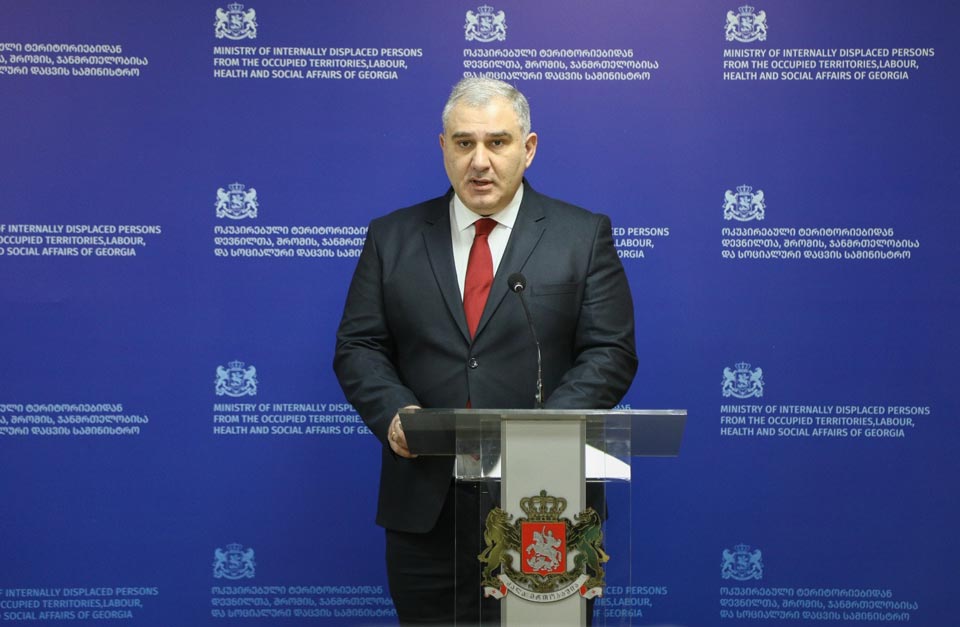
“So long as European states are still examining Duchenne medications and are in no hurry to reach a decision, it would be unfair of me to say that any single country is unwilling to spend USD 700,000 per patient annually,” stated Georgia’s Health Minister Mikheil Sarjveladze at a briefing.
He added that European countries are approaching the matter with measured caution.
“There is yet another medication whose EMA assessment states plainly: ‘Additional data are required to examine the extent to which the small quantities of truncated dystrophin produced affect improvements in patients’ mobility.’ Here, too, the necessity for further research and examination is abundantly clear.
Another medication also promises the potential to delay the need for a wheelchair. It holds authorisation from both the FDA and the EMA. However, based on credible open-source sources, there are documented cases of children dying while taking this medication in clinical practice. Ongoing research is actively investigating whether a causal relationship exists between these fatalities and the drug, with the hope of either establishing a link or confidently ruling one out.
European regulators are equally reluctant to rush the incorporation of this medication into state healthcare programmes. They are investigating the matter actively and thoroughly, and are preparing for decisions that could go either way. As of now, it remains uncertain which approach will ultimately be adopted, an important factor for us in assessing the safety and efficacy of these medicines. Given that European countries are still conducting investigations and show no urgency to reach a decision, I cannot fairly conclude that any nation is merely unwilling to spend USD 700,000 per patient annually. European countries are approaching this question with sound and prudent caution.
To be clear, then: what is being demanded is access to drugs whose function is neither to save lives, nor to cure the disease, nor to extend life expectancy. Medicines capable of those effects are what we all await and fervently hope for. The function of these particular drugs is solely to delay the point at which a wheelchair becomes necessary, and even on that count, serious questions remain regarding their efficacy and safety. It would be wrong to harbour expectations that these medications can cure the disease or prolong life.
It should also be noted that corticosteroids, already covered under the state programme and fully funded, in line with the practice of leading European countries, have a well-established, proven benefit in terms of both delaying wheelchair dependency and, more significantly, increasing life expectancy. Their safety and efficacy are not in question. Regrettably, there remains work to be done to ensure these medications are actually being used where they are genuinely needed, and that is a challenge in itself. The Ministry will continue its work both in assessing the safety and efficacy of available treatments and in responding to all other outstanding needs. This commitment extends beyond this specific condition to encompass a wide range of diseases, both rare and common, including oncological and neurological disorders such as multiple sclerosis, etc.
I should like to borrow the words of one expert in the field, who said at a conference: ‘The last ten years have been revolutionary for Duchenne muscular dystrophy, but today there are more questions than answers; more, indeed, than there were ten years ago.’ And that is quite true: ten years ago, there were no questions, because the answer was entirely without hope. Thankfully, questions have now emerged, and I trust that answers will follow before long. The developed nations with significantly greater financial resources than ours share this hope; nations that, to this day, have refrained from publicly funding these medications. It is precisely because those questions demand answers that European countries are holding back, not because any Scandinavian state lacks empathy or begrudges spending an average of USD 2.5 million per patient per year. European countries like Norway, Portugal, the Netherlands, and others are significantly more developed than Georgia, both financially and in terms of healthcare systems. It is neither fair nor logical to pose the rhetorical question of why these states have not included funding for these medications in their own healthcare programmes. That is precisely the question our country is working to investigate and understand,” Sarjveladze stated.