


Georgian PM credits people’s “wisdom” for choosing peace over violence in 2024 parliamentary elections
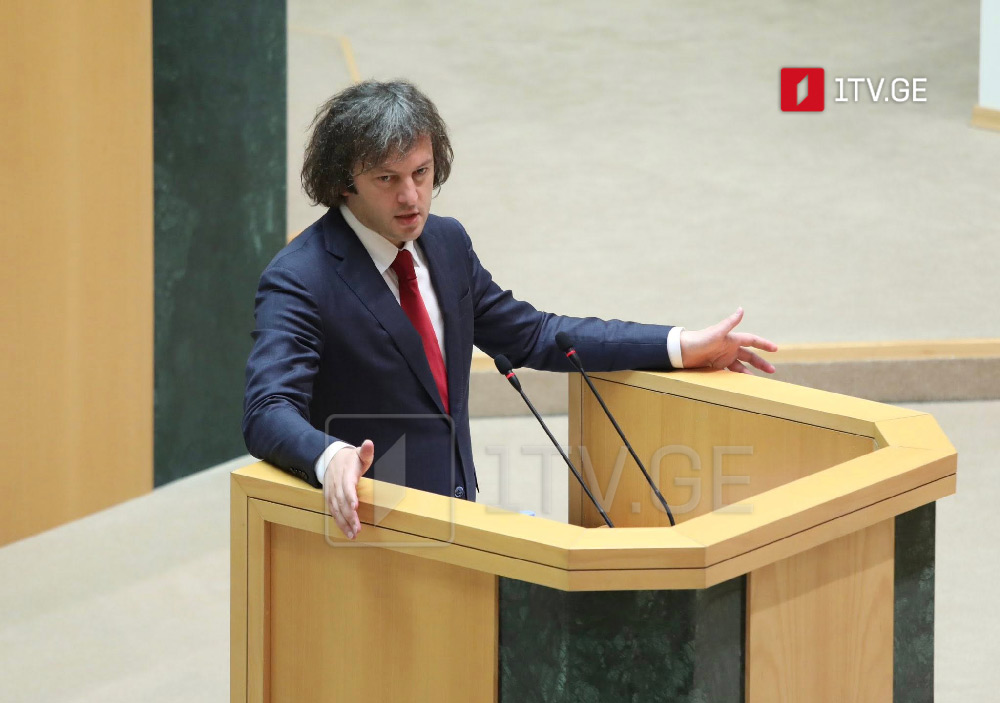
Georgia’s Prime Minister Irakli Kobakhidze used his annual parliamentary address to frame the country’s recent political turmoil as a foreign-backed assault on state sovereignty while crediting the Georgian people’s electoral choices with preserving peace and stability.
“Everyone remembers those very challenging five days when, according to a pre-developed plan, specific violent groups confronted state interests and state sovereignty,” Kobakhidze stated.
The Prime Minister emphasised that his administration would not tolerate any attempts to undermine constitutional order or state sovereignty.
“During the reporting period, we went through a significant process related to a violent attack on state sovereignty and the country’s constitutional order, which was carried out in late November and early December,” Kobakhidze stated.
“Everyone remembers those very challenging five days when, according to a pre-developed plan, specific violent groups confronted state interests and state sovereignty. All of this was carried out based on external interference, which was completely obvious. We could not allow anyone to violate state sovereignty and constitutional order,” the PM stressed.
The PM expressed particular gratitude to law enforcement agencies for their role in containing the protests.
“I want to express special thanks to our law enforcement structures, to every police officer of the Ministry of Internal Affairs who was involved in preventing this violent attack; thanks to the State Security Service, all law enforcement structures that successfully ensured the prevention of this attack,” he said.
Kobakhidze characterized the October 26 parliamentary elections as a crucial moment when Georgian voters made a “principled decision in favour of peace” despite what he described as serious external interference.
“The main gratitude belongs to the Georgian people because, without the Georgian people, their wisdom, and support, none of these results could have been achieved,” the Prime Minister declared.
“In this regard, the will of the Georgian people, which was expressed on October 26 last year in the parliamentary elections, was decisive. These were very challenging elections, there was very serious crude external interference, attempts to impose a false message, as if this was a referendum between Russia and Europe,” Kobakhidze said.
He reframed the electoral choice, stating: “Such messages are very well remembered by you, in reality, this was indeed a referendum, but what was at stake were two different things: war and peace. In the end, the Georgian people, precisely with their wisdom, made a principled decision in favour of peace. First of all, it is precisely the merit of the Georgian people that our country has peace today and the country continues stable development.”
The Prime Minister painted a picture of sustained external pressure aimed at weakening Georgian state institutions.
“Against the background of constant external agitation, some people thought that the state was weakened and decided to use violence against the state. Among them, the manifestation of this was also the November-December events. For some reason, many subjects were too bold towards our state,” Kobakhidze explained.
The Prime Minister warned against any future attempts to challenge state authority, whether domestic or foreign.
“We saw attempts to weaken state institutions from outside, to do all this with hidden financing, with external hidden financing they tried to damage the reputation of our church, they financed LGBT propaganda, political actions, etc. All this was happening secretly from the population of our country,” the Prime Minister went on to say.
Kobakhidze also highlighted what he characterized as direct interference in judicial independence, citing a specific incident involving diplomatic pressure on a Georgian judge.
“You also remember, for example, direct crude interference in the independence of the judiciary. Not just one interference, but I want to remind you of one specific fact. When a specific judge of our justice system was summoned by a representative of one of the embassies and was asked for a report regarding a specific case. The Constitution of Georgia was directly violated, the Vienna Convention was violated, and all principles of law and diplomatic relations were violated and trampled underfoot,” Kobakhidze stated.
He noted that the Strasbourg Court later vindicated the Georgian judge’s decision: “After that, you also remember that the Strasbourg Court also made a decision on this case and it fairly recognized the Georgian judge’s decision from beginning to end, but no one apologized.”
According to Irakli Kobakhidze, some believed they could manipulate or undermine the Georgian state. They assumed the state was fragile and, as a result, dismissed our sovereignty and the independence of our judicial system.
“Someone assumed that a foreigner could write our laws from outside our borders. I vividly remember just two or three years ago how foreigners—diplomats included, who should have no involvement in legislation—sat around the table with us, drafting laws, often bypassing us and imposing legislation on our country. They believed the Georgian state was fragile enough to be treated with such disrespect.
I also recall how they dictated from the outside who should remain in key positions, such as the Minister of Internal Affairs, and who should not. Such intrusions occurred for a certain period. They thought that insulting a policeman or slapping a police officer was acceptable and to be tolerated. They believed that refusing to recognize the results of parliamentary elections, that the parliament should not be part of the legislative process, and that we should start negotiations and sign anti-constitutional agreements based on these false assumptions.
They thought the state was too weak to defend itself and that they could treat Georgia as they pleased. Some believed that when a hydroelectric power station of strategic importance was to be built, certain individuals—whether foreigners or misguided locals—would come out and obstruct the process. They assumed the state lacked strength. Some, the wrong people—foreigners and even some locals—thought that external fluctuations could weaken Georgia and that they could oppose and undermine our sovereignty.
Today, we live in a completely new reality. “We will not allow arbitrariness and violence against the Georgian state under any circumstances—neither from within nor from outside,” declared Irakli Kobakhidze.