


Former State Minister claims UNM was lobbying against EU visa-free travel for Georgia
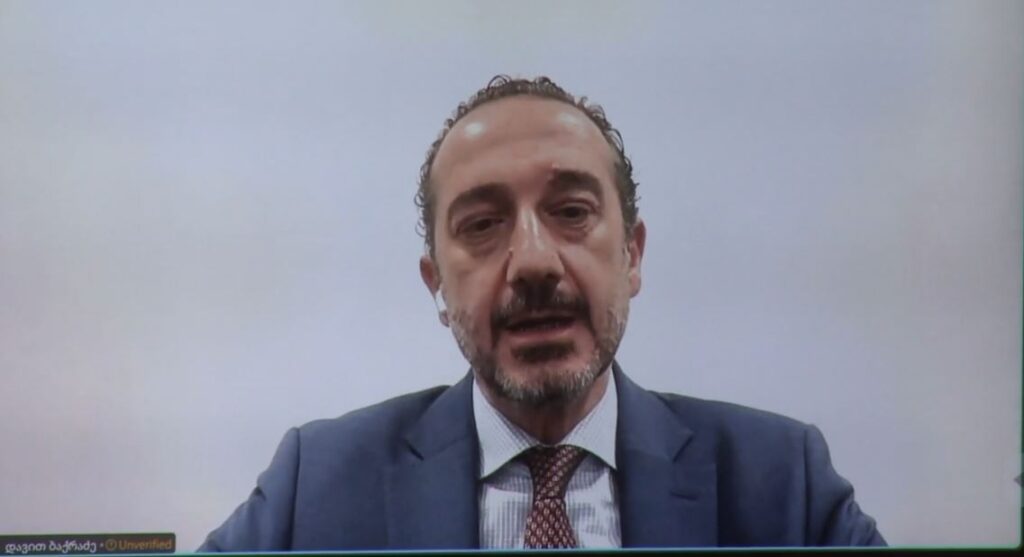
Georgia’s former State Minister for European and Euro-Atlantic Integration, Davit Bakradze, who currently heads Georgia’s Mission to the United Nations, has made accusations against the opposition United National Movement party, claiming they actively lobbied against granting Georgia visa-free travel to the European Union.
Speaking before Parliament’s Temporary Investigative Commission examining “Damage to Georgia’s Foreign Policy Interests by Certain Politicians from 2012-2025,” Bakradze detailed what he described as a sustained campaign by opposition politicians to undermine Georgia’s European integration efforts.
According to Bakradze’s testimony, while Georgia was actively working toward visa liberalization with the EU, the United National Movement (UNM) members spent months meeting with European officials and lobbying against granting Georgia visa-free travel status.
“When Georgia was actively working to achieve visa liberalization, UNM members spent months going around and lobbying against granting Georgia visa-free travel during meetings,” Bakradze stated.
“This became clear during high-level meetings with European Commission representatives, European Parliament members, and expert communities who traditionally have influence over political decisions,” he added.
Bakradze described the European officials’ reaction as one of bewilderment and indignation.
“They couldn’t hide their surprise and outrage that the leading opposition party, which had declared support for pro-European development, would question such a significant decision for the country’s population as visa-free travel with the European Union for their own political purposes,” he said.
The former minister revealed that the United National Movement had multiple lobbying contracts over a four to five-year period, totalling 5-6 different agreements with various lobbying firms at different times. These documents, available through the Foreign Agents Registration Act (FARA), show the extent of activities that complicated Georgia’s European integration efforts.
Bakradze highlighted one particularly problematic contract between the United National Movement and the lobbying company “Orion Strategies.” This contract caused significant embarrassment when it emerged that Batu Kutelia, who led a non-governmental organization and was a researcher at the Atlantic Council, was listed as a signatory. The Atlantic Council subsequently apologized for the situation.
“The materials uploaded to the FARA website directly show dates, meetings, and issues where prepared narratives were delivered to American politicians. The topics under discussion directly indicated that this was about a pro-Russian state, an anti-American state, and so on. This didn’t even have the form of discussion or debate,” Bakradze explained.
The opposition’s actions culminated in a crucial vote on April 14, 2016, during a meeting of the Association Parliamentary Committee. Despite recommendations for Georgia to receive visa-free travel with Europe, UNM representatives Giorgi Kandelaki and Tariel Londaridze voted against the proposal.
Bakradze noted that some members of the European People’s Party also opposed the measure, but the decision was ultimately approved by a simple majority, recommending visa-free travel for Georgian citizens without any conditions.
The testimony revealed that opposition parties attempted to attach conditions to Georgia’s visa liberalization. The UNM wanted the legal dispute over Rustavi 2 television station ownership to be halted as a precondition for visa-free travel. Bakradze characterized this as wanting “to leave stolen property in the hands of the thief” based on subsequent court decisions in Georgia and Strasbourg.
The European People’s Party, a partner of the UNM, also sought to delay the decision until after the elections with party leader Joseph Daul visiting Georgia in March 2016 and meeting with imprisoned United National Movement members.
Bakradze described how Joseph Daul’s visit created additional complications. Despite meeting with convicted UNM politicians including Vano Merabishvili, Bacho Akhalaia, and Gigi Ugulava, Daul maintained that Georgia would eventually receive visa-free travel but that the process should be delayed.
“From the European People’s Party statements, it became clear that if Georgia received visa-free status before elections, this would strengthen the ruling party and its authority – this was the main opposition to this process,” Bakradze explained.
His testimony painted a picture of opposition parties using Georgia’s European integration aspirations as a political weapon against the ruling Georgian Dream party. Bakradze argued that in their domestic political struggle, the opposition was willing to damage state interests and delay benefits for Georgian citizens.
“European politicians and this visit clearly showed that in opposition to the Georgian Dream, as the elected government, the country’s and population’s geostrategic aspirations were used as an instrument,” he concluded.
Georgia eventually received visa-free travel to the EU Schengen zone in 2017, allowing Georgian citizens to travel to European Union countries for short stays without requiring a visa.