


FM Botchorishvili: When it comes to connectivity, Georgia’s absence from negotiations embarrasses EU far more than it does Georgia
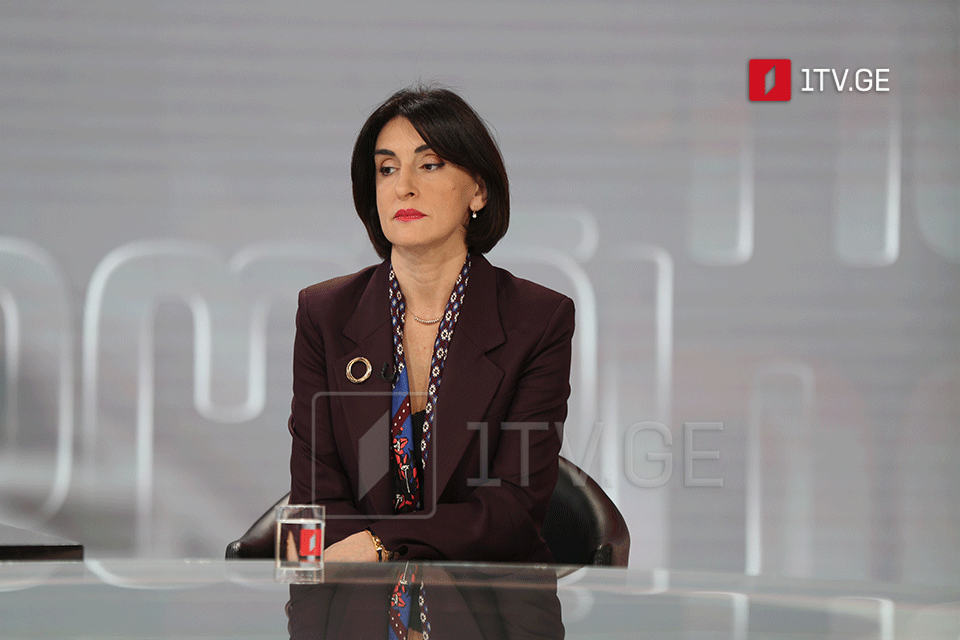
“While there is extensive discussion about connectivity taking place in Brussels and across the European Union in various formats, there is a tendency to avoid publicly mentioning Georgia. This creates a somewhat ridiculous image within the EU and places those who speak about Georgia but refrain from mentioning it in an awkward position,” stated Minister of Foreign Affairs Maka Botchorishvili. She made this remark during the GPB First Channel programme Topic of the Day, in response to a question about the interest European partners have shown in Georgia’s transit potential at the Economic Security Forum in Greece, where she attended.
“It is a simple matter. All you need to do is look at a map to understand the European Union’s perspective on connectivity. This is vividly illustrated in official documents, conclusions, and policy papers produced in Brussels, where the route is always clearly visible. However, in public discourse, some individuals and actors deliberately avoid mentioning it, likely to craft a political narrative suggesting that Georgia has disappeared from the EU’s map. But Georgia cannot vanish from the map. It most certainly has not vanished, and here we are, fulfilling a role and function of vital importance to Europe when the conversation turns to connectivity. The EU may have been rather late to this process; a great deal could have been done sooner, and discussions on Black Sea connectivity in particular could have begun far earlier. We were raising this in Brussels ten years ago, speaking to our colleagues about it. But today, it has become so self-evidently necessary that it can no longer be sidestepped. However much one tries, it’s impossible to bypass it, especially when discussing connectivity in Georgia. Everyone understands this perfectly, yet they still hesitate to voice it publicly,” Botchorishvili stated.
She added that the Georgian government is simply getting on with the work of serving Georgia’s interests.
“We know our role and our function very well. This country, on the contrary, has its hand extended in cooperation, extended so that we may create opportunities for our nation. On one side lies Europe and the European Union; on the other, the countries of Asia. We find ourselves in the middle, with both the obligation and the opportunity to foster collaboration on both sides. Of course, cooperation cannot be developed unilaterally; it requires the willingness and commitment of both parties,” Botchorishvili has added.
Asked by presenter Tamta Sanikidze how Georgia’s growing transit potential, particularly given the activation of the Black Sea submarine cable, recently granted special status by the EU, and the planned supply of renewable energy to European countries via Georgian territory might influence future Georgia-EU relations, and whether this factor could serve as a catalyst for easing the tensions that have marked the Brussels-Tbilisi relationship in recent years, Botchorishvili replied that this was precisely her point.
“The way things stand now, there is simply no getting around it; nothing can be done to bypass Georgia. Many are already beginning to recognise this inescapable reality. Indeed, it can be argued that Georgia’s absence from the table during discussions on connectivity now appears to make the EU seem rather absurd—far more so than Georgia itself. They are sitting there debating connectivity, yet the central country along that entire corridor has not been invited. Which is the more absurd position to discuss connectivity while excluding the very nation through which the connection must pass? This raises serious questions about how genuinely these discussions are being taken and how thoughtfully connectivity is being considered. These are questions that must be addressed within the EU itself. Is today’s Brussels truly doing everything necessary to secure the EU’s future? Because that future largely depends on it. Relations with our neighbouring countries and dialogue with the South Caucasus are of critical importance,” Maka Botchorishvili concluded.