


EU security cannot be guaranteed without peace and stability in its neighbourhood, says Georgia’s Foreign Minister
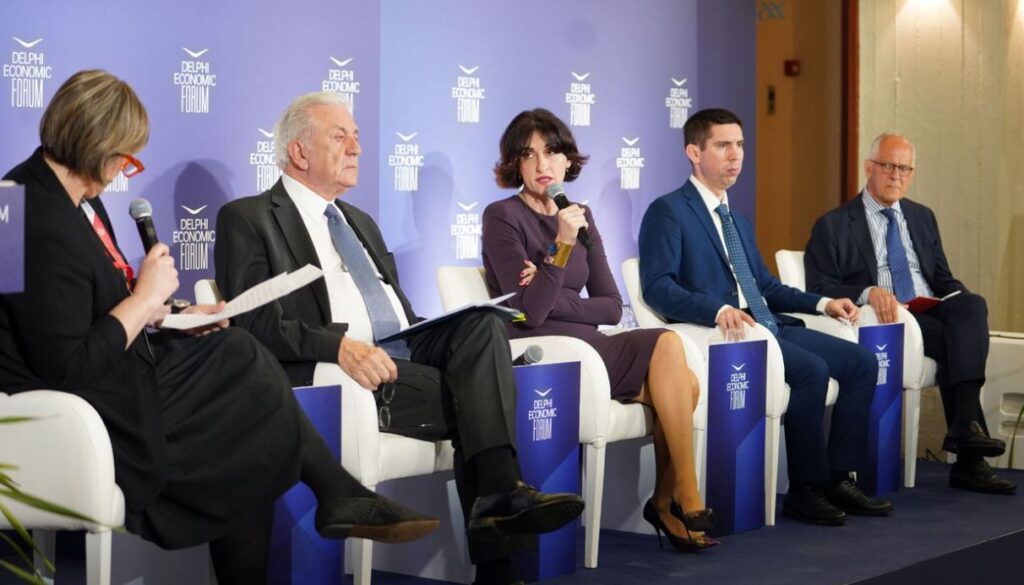
Georgia’s Vice Prime Minister and Minister of Foreign Affairs, Maka Botchorishvili, took part in a working session entitled “The Shield of Enlargement: Security as the New Accession Pillar” at the Delphi Economic Forum, currently underway in the Hellenic Republic.
In her address, the Minister addressed the question of strengthening European security, emphasising that when discussing European security, one must not draw a dividing line between the European Union and the countries beyond its borders, for the EU’s security cannot be guaranteed without peace and stability in its neighbourhood.
“First and foremost, when we speak of security, we must consider the challenges that lie before us. In discussing European security, we ought not to separate the European Union from non-member states, because we share common needs and common security interests. If we cast our minds back to the events in Georgia in 2008 and the years prior, and consider the impact of the ongoing war in Ukraine on the European security architecture, it becomes clear that the EU’s security cannot be assured without peace and stability in its neighbourhood.
At the same time, Georgia’s own security cannot be considered in isolation from that of the European Union. It is precisely for this reason that, when it comes to security, we must think and act together,” said Maka Botchorishvili.
The Foreign Minister underscored that the Black Sea region and the South Caucasus are of critical importance to European security, and that modern security can no longer be confined to its military dimension alone; it demands a broader, more multifaceted approach.
“Today, security is no longer solely a matter of military force and capability. Any serious understanding of security must encompass economic resilience, connectivity, and sustainable development. If one looks at the map, there is a line, understated perhaps, yet critically important to Europe, running through the Black Sea region and the South Caucasus. This is a region of immense significance to European security, and that is precisely how we see it, because we regard ourselves as part of the European security architecture. This is an essential factor that must be taken into account whenever we speak of building European security,” the Foreign Minister declared.
A considerable portion of Maka Botchorishvili’s address was devoted to Georgia’s European integration process.
“Georgia’s path towards European integration is unwavering: it is part of our identity and a historic choice. It is a choice grounded in values,” said Botchorishvili.
The Minister further stressed that the enlargement process must be viewed through a broad geopolitical lens.
“Enlargement is a geopolitical process, and a geopolitical necessity. It must not become a casualty of narrow bureaucratic approaches, for that would undermine its very purpose. Enlargement is not an end in itself; it is an instrument we employ in pursuit of something far greater: the assurance of shared security and peace,” the Minister observed.
Maka Botchorishvili also drew attention to the security challenges facing Georgia, among them the Russian occupation of Georgian regions and the deeply complex geopolitical environment in which the country finds itself.
“Despite an extraordinarily difficult geopolitical environment, we have succeeded in preserving peace and stability within the country, in safeguarding democratic institutions in the face of repeated assaults upon them, and in sustaining consistent development, which is to say, stable economic growth,” the Foreign Minister stated.
In closing, Maka Botchorishvili affirmed that Georgia would continue to take the necessary steps to lay firm foundations for its accession to the European Union.
“We continue to pursue the development and reforms that matter to our country, so that a solid foundation for EU membership may ultimately be established, for that is the choice of Georgia and of the Georgian people,” the Foreign Minister concluded.