


Constitutional Court opens hearings on lawsuit to ban five opposition parties
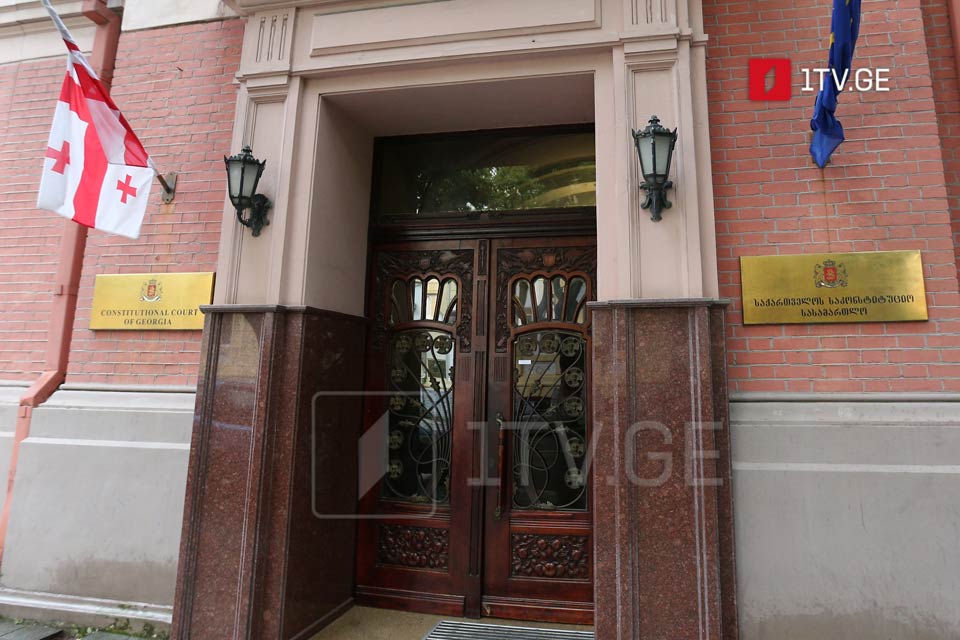
The Plenum of the Constitutional Court of Georgia begins today a substantive hearing on the lawsuit seeking to declare the activities of five political parties unconstitutional and to ban them. Hearings will start at 12:00 on 21, 22 and 23 October.
The case is “Constitutional Lawsuit by Members of the Parliament of Georgia (88 Members in Total) on the Constitutionality and Prohibition of the Activities of Political Parties (Unity – National Movement; Coalition for Change Gvaramia Melia Girchi Droa; Strong Georgia – Lelo, For the People, For Freedom!; Federalists Party; Gakharia for Georgia)” (Constitutional Claim No. 1979).
According to the Constitutional Court, the plaintiffs firmly believe that all five parties named in the lawsuit have violated the first sentence of Article 23(3) of the Constitution of Georgia. On the one hand, this has already taken the form of attempts to overthrow and forcibly change Georgia’s constitutional order; on the other, it is evident in their continuing aim to overthrow and forcibly change that order in the future.
According to the lawsuit, the constitutional grounds of undermining the country’s independence and violating its territorial integrity are also relevant in assessing the constitutionality of Unity – National Movement’s activities. More specifically, the authors of Claim No. 1979 develop their arguments along several lines. The first is the overthrow and forcible change of Georgia’s constitutional order. They say this has taken the form of systemic and systematic violations of human rights by the parties concerned or their members, refusal to recognise the legitimacy of bodies and officials elected in general elections, and attempts to overthrow or forcibly change the constitutional order. The second is undermining Georgia’s independence and violating its territorial integrity, which they say took the form of events linked to the August 2008 war and events that unfolded after 2012.
The claimant argues that, since 2016, the respondent parties have continuously rejected the domestic and foreign legitimacy, and therefore the constitutionality, of Georgia’s current government and ruling party. According to the claimant, the following circumstances confirm that the parties share the same unconstitutional aims:
- For years, in elected bodies, in Georgia’s political processes, and in the sabotage waged against the Georgian state, they have taken essentially the same positions, formed a coalition-like alliance pursuing a common goal, and still act this way today.
- Former or current leaders of the respondent parties were elected to various convocations of the Georgian Parliament on the lists of Unity – National Movement or of electoral blocs it took part in.
- They held various party posts in Unity – National Movement.
- During Unity – National Movement’s time in government (2004–2012), they held various senior posts, including political and state-political positions, and/or, during the same period, Unity – National Movement violated human rights with their assistance and participation.
“In light of the above, the claimant considers that the facts and arguments presented in the claim, taking into account the Constitution of Georgia and the approach of the European Court of Human Rights, together form a solid constitutional basis for banning unconstitutional political parties. The claimant, Members of the Parliament of Georgia, therefore asks the Constitutional Court, under the first sentence of Article 23(3) and Article 23(4) of the Constitution, to declare the respondent parties’ activities unconstitutional and to ban them,” the Constitutional Court said in its statement.
GPB First Channel will broadcast the hearings live and share the feed with other media.