


Constitutional Court Judge Eva Gotsiridze presses UNM over whether state abuses should be attributed to the party
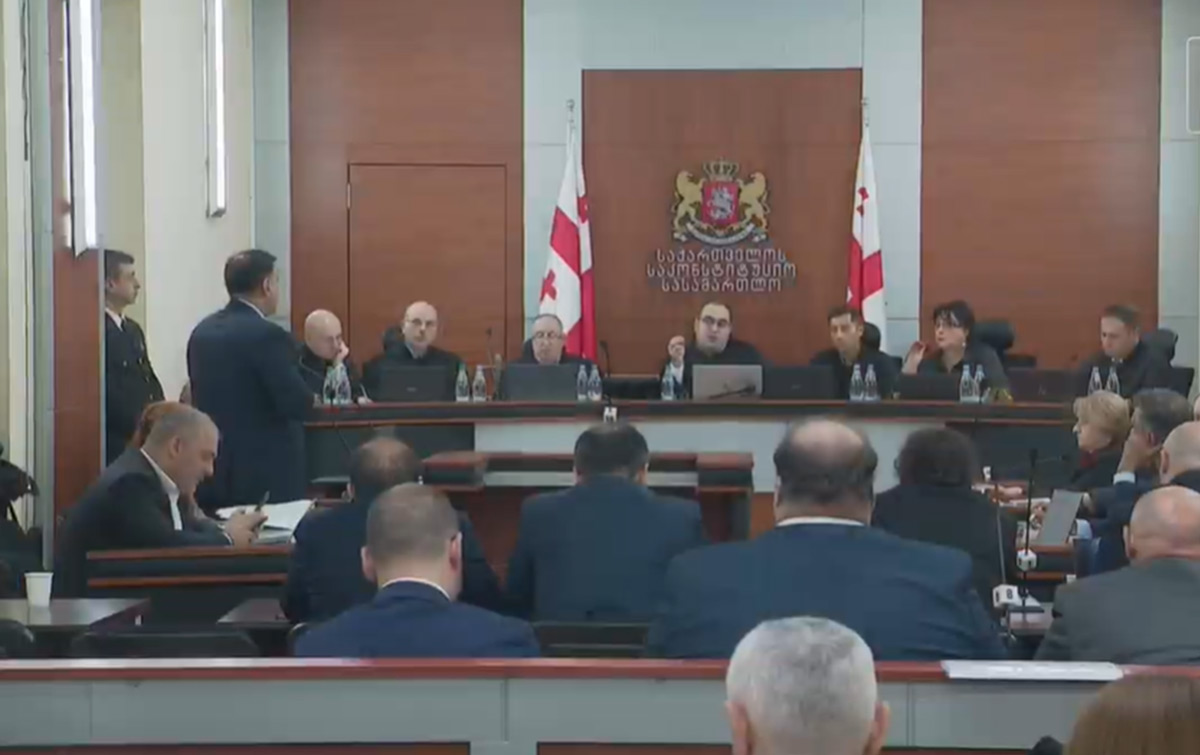
“The Buta Robakidze murder case, Girgvliani, Vazagashvili, Khubulov, the Vazagashvili bombing case, the Roin Shavadze case, the Tsindeliani and Kardava murder case, the assault cases involving Valeri Gelashvili, Malkhaz Azarashvili and Zaza Meskhi, Vamekh Abulashvili and Kakhaber Dabrundashvili, and Koba Davitashvili, the 15 June case, the assault on war veterans, the 26 May case, the Kintsvisi operation case, the murder of Colonel Sergo Tetradze, the Evgeni and Omekh Aprasidze case, the 7 November case, and the Lapankuri operation case—almost all of these cases, with only a few exceptions, ended in loss of life,” Constitutional Court Judge Eva Gotsiridze stated during today’s hearing.
Gotsiridze noted that what unites these cases is that they were perpetrated by state agents or representatives of the state, and that, except for the Girgvliani murder, verdicts in all of them were only handed down after 2012, once investigations were launched.
Judge Eva Gotsiridze challenged representatives of the United National Movement (UNM) during today’s hearing over whether high-profile crimes committed by state agents before 2012 should be attributed to the former ruling party.
“All these well-known cases, which are also cited in the commission’s report: the Buta Robakidze murder case, Girgvliani, Vazagashvili, Khubulov, the Vazagashvili bombing case, the Roin Shavadze case, the Tsindeliani and Kardava murder case, the assault cases involving Valeri Gelashvili, Malkhaz Azarashvili and Zaza Meskhi, Vamekh Abulashvili and Kakhaber Dabrundashvili, and Koba Davitashvili, the 15 June case, the assault on war veterans, the 26 May case, the Kintsvisi operation case, the murder of Colonel Sergo Tetradze, the Evgeni and Omekh Aprasidze case, the 7 November case, and the Lapankuri operation case, most of them involve murder, and all involve violence; almost all, with only a few exceptions, ended in loss of life. Several defining characteristics unite them. First, state agents or state representatives perpetrated them. Second, apart from the Girgvliani murder, not a single case was properly investigated or resulted in a conviction during your time in office; verdicts were only secured after 2012, once fresh inquiries were launched. And third, those subsequently convicted in connection with these killings and found to have played a major role, whether Akhalaia or Kodua, Kajaia, Mikadze, Pirtskhalava, Megis Kardava, and so on, were decorated by the President. First, when a state agent commits a crime, the taking of a life or the use of force in circumstances where there was no absolute necessity; second, the failure to investigate, where the state bears culpability in every single instance; furthermore, the encouragement of all this through the decorating of killers; it would be interesting to hear how you assess this. Who is to blame for all of this? Does the ruling party bear no responsibility whatsoever? Should these criminal acts be attributed to the United National Movement or not?” Eva Gotsiridze stated.
In response, UNM representative Levan Bezhashvili argued that a political party, as an independent legal entity, cannot be held criminally liable for the actions of state bodies, and accused the judge of posing a politically driven question.
“A political party possessed neither investigative functions nor investigative authority, and crimes cannot be attributed to it,” Bezhashvili stated.
“I do not believe the question you have framed is one befitting a judge or a jurist. In my view, it invites a political assessment rather than a legal examination; I perceived political motivation in that question,” he added.
The Constitutional Court is continuing hearings on a lawsuit filed by the ruling Georgian Dream party seeking to declare unconstitutional and ban five opposition forces: the United National Movement, Coalition for Change, Strong Georgia – Lelo, Federalists, and Gakharia For Georgia.