


Georgia’s Interior Minister: Had provocative banners been used during the match, developments could have spun out of control
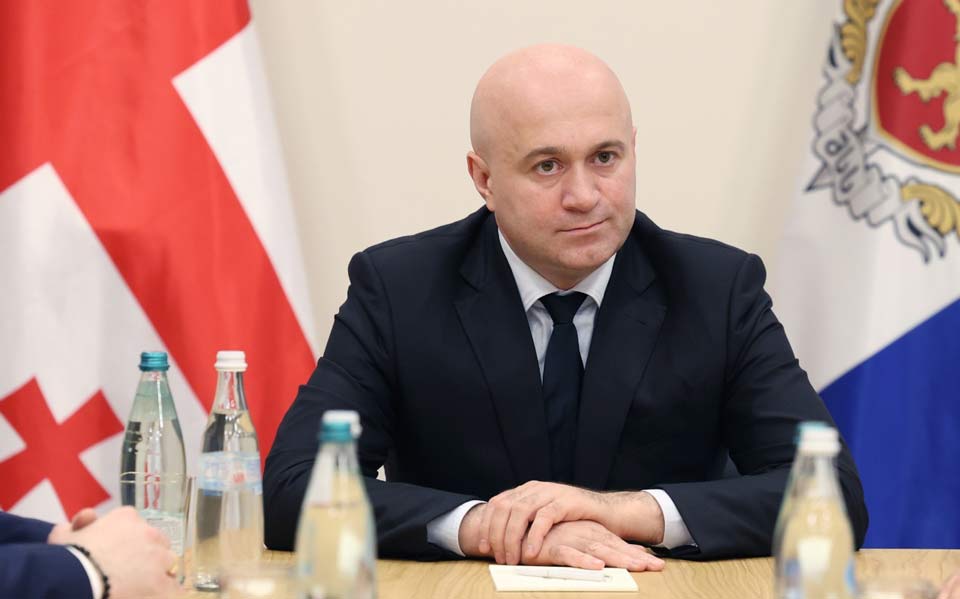
Georgia’s Interior Minister, Sulkhan Tamazashvili, has confirmed a telephone conversation with his Turkish counterpart, Mustafa Çiftçi, over the Beşiktaş and Hapoel Be’er Sheva match, and said that had he possessed a recording of the call, he would have released it in full.
As is known, a video recording of the phone conversation between Sulkhan Tamazashvili and Mustafa Çiftçi circulated in several Turkish media outlets.
“To my surprise, I listened to this recording too. I confirm that I spoke with my colleague yesterday. Of course, I did not record our conversation, though had I had such a recording, I would certainly have released an extended version.
I would have highlighted a more interesting part of the conversation, when I shared with my colleague that we were already aware of the situation in the first half of the day. Football fans had posted banners of a highly provocative nature on open sources and social media, posing alongside a banner that was offensive to our country. This provoked a strongly negative reaction from our citizens,” Tamazashvili noted.
According to the minister, the Georgian side carried out effective prevention at the border.
“We effectively prevented this at the border; as part of police operations, the entry of these banners into the country was thwarted. Roughly a hundred banners of a very foul, provocative nature, some of them very large, were seized and confiscated. Shortly afterwards, still before the match, information was exchanged via police attachés, and our counterparts thanked us for it. Later on, I shared this exact information with my colleague. I explained, amongst other things, that had banners of this nature been used inside the stadium during the match, events could genuinely have spiralled out of control. That is precisely why I would like to thank the staff of the Ministry of Internal Affairs, who worked remarkably effectively.
These banners began circulating in open sources at around 2:00 to 3:00 pm, and by the evening, the attempt had already been thwarted. Not a single banner was displayed in the stadium during the sporting event, which is both commendable and of great importance.
I began the conversation with my colleague with this point, for which they thanked us. They then asked a question regarding the removal of the flag, for instance, why it became necessary, and I replied that our side did not initiate this. It is also clear from the footage that no state representative approached the area; this is regulated under UEFA rules. Banners of such a nature, including flags, that could potentially cause unrest and tension during a sporting event are prohibited. A UEFA delegate was present at the stadium. A pre-match meeting is held before every game where issues of this kind are discussed. That meeting addressed this specific matter, and UEFA representatives stipulated that aside from the national flags of Türkiye, Israel, and Georgia, given that the match was taking place in our country, no flags or symbols of other nations were to be displayed. This condition was breached, and the UEFA delegate instructed that, as agreed, it had to be removed. The member of staff who went over and requested the flag’s removal belonged to a private company hired and contracted by Beşiktaş, which was tasked with carrying out this action,” Tamazashvili stated.
For context, Georgia’s Ministry of Internal Affairs released a statement regarding the Beşiktaş and Hapoel Be’er Sheva match. The statement noted that “observing the requirements of Georgian legislation on the territory of Georgia is mandatory for every person, regardless of their citizenship or nationality.”